Examining Epistemological Foundations

Introduction

The most significant element to the discussion of text-criticism and Bible translations is that of epistemology. Christians recognize two forms of revelation, natural and special. In the first place, men and women know things because they are made in the image of God, and can use their reasoning to come to conclusions. This natural reasoning and sense observation is not sufficient to bring anybody to a saving knowledge of Jesus Christ. Secondly, in special revelation, God speaks so that men may know His revealed will. The question we have to ask ourselves as it pertains to the textual discussion is, “Is my epistemological starting point in line with what God has revealed in Scripture?” 

One of the purposes of this blog is to demonstrate that “modern text criticism” begins epistemologically in a different place than the Scriptures. That does not mean that self-identifying Evangelicals who engage in text-criticism necessarily have anti-Scriptural epistemological starting points, just that the various methods, as defined, assume a certain epistemological starting point that is incompatible with Scripture. In other words, one can employ modern text criticism from a Christian epistemological perspective, and still be starting from the wrong place by adopting some or all of the axioms of a method that assumes no such foundation. 

For example, in mainstream textual criticism, the most popular and accepted position is that the Scriptures went through a recension, or editing process, which resulted in what is commonly called the Byzantine text platform. Some say this happened all at once (Lucian), and others say that this happened gradually (Wachtel). The concept of a Scriptural recension is not a historical fact, or a neutral fact, it is an interpretation of data which has an epistemological starting point. That starting point is that the Scriptures were not kept pure in continuous transmission. In order to arrive at this conclusion, one must assert that the Scriptures changed dramatically in their transmission to explain why the majority of the later manuscripts look very different from the early minority of manuscripts. The reason that this is an epistemological problem is because the extant evidence in the 21st century cannot demonstrate, without a shadow of a doubt, either of these perspectives. 

Evidence or Epistemology? 

There is no way to prove by way of extant data that the original text of Holy Scripture looked like Vaticanus, or P75, or any of the commonly called Alexandrian manuscripts. In the same way, there is no way to prove that family 35, or the TR, or the Tyndale House Greek New Testament exists in exactly the same form as the originals. The same goes for individual readings within the manuscript tradition. Even if we had 1,000 copies of Mark from the fourth century that looked exactly the same, evidence driven models cannot validate that those copies are accurate to the original because we don’t have the original. That does not mean that we cannot know what the original New Testament said, just that the modern text criticism in the 21st century is not a justifiable means to determine the text. So then, in the absence of sufficient building materials for a reconstruction effort, epistemology is without question, the most important component to this discussion. 

If the Scriptures teach that the Word of God will not fall away, and that in every generation, God’s people had access to that pure Word, then such ideas as a recension cannot even be entertained without violating that epistemological principle. On the same premise, any idea that supposes that a small sample of early extant manuscripts represents the scope of the whole of the manuscript tradition, or at least does so in part, also is a violation. In order to adopt an Evangelical epistemology and a modern critical epistemology, one must interpret the conclusions of modern criticism, which violate Christian epistemology, by Christian epistemological foundations. This is perfectly exemplified in the discussion of creation. If Darwin’s premise (or something similar) is adopted as the epistemological starting point, then Christians must make sense of Genesis 1-12 in light of that starting point. Rather than rejecting Darwin and friends, evolutionary theory is adopted as a hermeneutic principle rather than the Scriptures themselves. The result is the rejection of a literal creation, a literal Adam, a literal flood, and so forth. This is yet another issue that is said to be doctrinally “neutral,” I’ll remind you. 

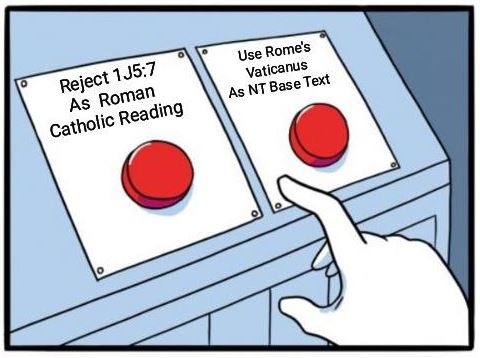
It would be irresponsible to say that adopting any form of theistic evolution is purely based on examination of evidence and making the best determination possible from that evidence. Rather, one must say that from a certain epistemological starting point, the data must be interpreted in this way or that. In the same way, extant manuscript data is not examined neutrally. One is not simply making the “obvious conclusion based on the data” when they reject 1 John 5:7, they are making an “obvious conclusion based on the data” from one particular epistemological starting point. If one wants to make the claim that a lack of evidence for 1 John 5:7 in many manuscripts demonstrates that all manuscripts before those didn’t have it, he is doing so from his epistemology or interpretive lens.

A manuscript says nothing absolute regarding the manuscript it was copied from, unless one makes certain assumptions. If the manuscript is truly the only guide, then the only thing that can be determined is that this manuscript, at this point in time, looked this specific way. The scribe of that manuscript could have easily removed a reading from his exemplar, which was then copied forward. One can make observations of scribal habits of one particular manuscript, but the scribal habits of one manuscript says nothing about the exemplar from which the scribe copied. If there is an extant archetype of that manuscript, more can be said, but in the case of the Scriptures, there is not a continuous line of transmission that can be observed, so any difference form one text to another must be interpreted from an epistemological starting point. Did scribes copy carefully, or did they not? Are the “original” readings longer, or shorter? Do earlier manuscripts contain more errors, or less? Since there is no extant pure line of manuscripts that goes back to the apostles, the amount of “neutral” observations that can be made about a manuscript is extremely limited. Thus, a Christian should be chiefly concerned with whether or not the lens he is examining evidence with is that which comes from the Scriptures. Anything else is a critical perspective of the Christian Scriptures as interpreted by a Christian. 

Epistemology Has Consequences to the Text of Scripture

The reason that those in the Received Text camp perceive modern critical text positions as so “dangerous” is because of the epistemological starting points of modern critical methods, not necessarily the Christians who adopt these methods. These methods, regardless of who uses them, do not assume basic Christian epistemological realities. An example is how evangelicals affirm that the Scriptures were “without error in the original” and also adopt the modern critical perspective that grammatically difficult readings are to be preferred as earlier than grammatically smooth readings. A system which does not comport with Scripture is not something that needs to be “redeemed,” but rejected. 

“Text criticism” itself is not the problem, it is the type of text criticism that is the problem. It was recently said that the Reformation era printed texts, and possibly all copied texts, were simply all “reconstructed texts” from the past. The Received Text position then is no different than modern text criticism other than the selected “reconstructed text” is different. That is to impose an epistemological concept upon the men of the past that simply did not exist prior to the age of reason in any meaningful way within the bounds of orthodoxy. One of the greatest errors of modernity is believing that “we know better” or to impose our modern epistemology upon men of the past. This is especially demonstrated when modern interpreters of historical theologians read their perspective into men of the past. 

It is often the case that the most “powerful” arguments against the Received Text are simply unfounded assertions that can in no way be substantiated in the kind of way that the argument requires. For example, it was recently said that the burden of proof is equally upon somebody to prove a reading original as it is to prove it unoriginal. This assumes that without reconstruction of every line of the text, there simply wouldn’t be a Bible, and that Scripture is guilty until proven innocent. If the belief is that the people of God had the pure Scriptures in every generation, then the burden of proof is demonstrably upon this generation to prove a Scripture not original from the previous generation. When the extant evidence is examined, it does not seem that engaging in such a practice is warranted, or profitable in any way. Can extant evidence demonstrate a reading to be original or unoriginal? Absolutely not. Therefore it is far more important to examine the epistemology from which a claim flows in the textual discussion. Is it the job of Christians today to determine the text of Scripture from evidence, or receive the text of Scripture from the previous generation? These are epistemological questions, not text critical ones. 

The Epistemological Foundations of Both Sides

In order to cut directly to the heart of the issue, the most fundamental epistemological starting point of modern text criticism is that there was no continuous line of transmission of the text, that the text was incorrectly identified at the advent of the printing press, and as a result, modern Christans and non-Christians must work together to reconstruct the text as it existed prior to a major recension, or perhaps various gradual recensions. This task is of such a tall order that after nearly 150 years, no method and no scholar has ever achieved success in reconstructing the original, and those still working are increasingly skeptical that that can actually be done. Despite this, the primary purpose of the extant data is still seen as adequate building materials. 

On the other hand, those in the Received Text camp begin by stating that the immediately inspired Word of God has been “kept pure in all ages.” The extant data is not to be used as building materials today, because nothing needs to be built. The purpose of the extant data then serves the people of God in a different way than is assumed by modern critical methods. The task of the church today is not to reconstruct the New Testament, but to receive and defend the text handed down from the previous generation. This is the major disconnect between those in the Received Text camp and modern critical camp. In the modern critical perspective, since the text is assumed to have fallen away such that it needs to be rebuilt, the extant evidence is purposed to demonstrate that the Received Text is not pure, and thus to justify reconstruction. Since the text from the previous generation is deemed impure, extant evidence resembling the text of the TR must also be counted as such, discrediting nearly all of the extant New Testament data. If it could be agreed upon that the responsibility of the church is reception, not reconstruction, then the question of determining “which TR?” would not be one that serves a mere polemic purpose. The church should be rallying around receiving a text, not dividing over which modern reconstruction is the most accurate, and why the Received Text is wrong. 

While it is easy to think that the first assumption of the modern critical perspective is that the TR is in error, it is that God did not continuously preserve the Word in every generation. In other words, it is not a data driven assumption, it is an epistemologically driven assumption. It is an assumption that rests almost entirely on the claim that what is extant today represents what the church had historically. In order to conclude that the TR is in error in the first place, one must assume that the extant data available today is also better than the data available in Europe at the time of the advent of the printing press, and even further that the data available in every generation before that could not have looked like the TR. One has to discount the reality that countless thousands of manuscripts have been destroyed since the 1st century. It is a terribly rash conclusion to make, considering how dangerous the outcome of that conclusion is. 

There is simply no way to responsibly say that the extant data today is “better” than the extant data available during the times when that extant data was being used and copied. So when somebody makes the claim that “the church didn’t read this in the text for the first 1,000 years,” they are doing so from an entirely assumptive and arbitrary place. They are interpreting extant data through an epistemological lens which says, “I know for sure that we know more,” even though that is a lofty claim to make based on the history of the text as it exists in extant manuscripts. Is it not a fair assumption to make that there were more than three manuscripts of Revelation circulating in the third century, and that the people of God knew what was in those manuscripts? And yet the modern critical method says, “Yes, we know more with our three manuscripts about Revelation as it existed in the third century than those who used manuscripts of Revelation in the third century.” Such a perspective is clearly driven by epistemological assumptions. 

Conclusion

In this discussion, I have found that epistemology is rarely addressed. It is easier to focus on extant data rather than discussing the lens by which men are viewing that data. Yet, if the lens that the data is viewed is flawed, then the conclusions made about that data can also be flawed. And if that lens is in opposition to Scripture, it is necessarily flawed. The common justification for approaching the Bible from a reconstructionist perspective is that, “God didn’t keep His Word pure, so we shouldn’t impose that perspective on the text.” Yet, there are a fair number of verses that teach that God’s Word will not pass away. Matthew 5:18 affirms down to the jot and tittle. Jesus connects the fulfillment of His ministry with His words (Matthew 24:25). The Psalms constantly speak of the Law being perfect, pure, and refined. The Scriptures say that “all Scripture” is necessary for matters of faith and practice, not just “some.” 

If we can agree that God did promise to continue speaking in the Scriptures, and that those Scriptures would be preserved until the Last Day, then a meaningful dialogue can take place on how we define the precision of that preservation. This conversation cannot take place currently, however, because those on both sides stand on different epistemological foundations. There is no common ground to be had between a person who says the Word of God is preserved and a person that says that the Word of God is not preserved. If the goal is to give confidence to the people of God in their Bible, it does not follow that we do so by starting with the premise that we have not yet successfully found God’s Word. And if our goal is to approach matters of text criticism faithfully, it does not follow that in our text critical axioms we assume that the earliest texts we have were not grammatically harmonious. The problem is not with “text criticism,” it is with epistemology, and the type of “text criticism” we advocate for and support. 
Different Theological Perspectives on the Text of Holy Scripture

Introduction

In the modern church, there is an abundance of theological views on the text of Holy Scripture. These include higher critical perspectives, neo-orthodoxy, continued revelation, providential preservation, and modern criticism. All of these views understand the essence and purpose of Scripture in different ways. In order to examine these theologically, I will assume a popular definition of inerrancy – that the original manuscripts were without error, and that the text as it is available today is without error in all that it teaches. In this article, I will examine each of these views against the doctrine of inerrancy and the effort of modern text criticism. In examining these perspectives, it should be apparent the similarities and differences between them. 

Higher Critical Perspectives 

There are a wide range of higher critical perspectives of the Scriptures, and typically those that adopt this view reject inerrancy outright, because it involves understanding the Bible as a human product – though many modern views adopt higher critical principles without calling it higher criticism. From this perspective, the study of New Testament scholarship is not concerned with what God has said, but rather, how different faith communities experienced their historical context and expressed that experience in writing. Modern text criticism is friendly to this perspective because the effort of modern text criticism is to detail the history of the manuscript tradition. Higher critical perspectives make a distinction between actual history and how faith communities experienced history. Thus, the Bible is a record of how Christians experienced history, which is said to be different than what actually happened in history.   

Neo-Orthodox Perspectives

There are also a wide range of neo-orthodox perspectives on the text of Holy Scripture, and those that adopt this view typically reject inerrancy, as the Bible is said to contain historical errors from this perspective. In some more extreme views in this camp, the definition of “Scripture” is not set in stone, as anything can become Scripture when the Holy Spirit works in it (Brunner). More common within this view is something closer to Karl Barth, which attempts to remove any human attempt to make God less sovereign or infallible by saying that the Scriptures, as they exist in the Bible, become the Word of God when the Holy Spirit bears witness in the believer’s heart as he reads. In this way, even if the Scriptures are not inerrant, God still speaks infallibly in the Word. The Bible is not the Word of God, Jesus is the Word of God, and the Bible is the artifact of revelation, which testifies to the Word of God, Jesus Christ. This artifact becomes the Word of God when the Holy Spirit works in the believer’s heart. This view is compatible with the modern critical text, because God speaking is not tied to an ontological text, but rather is tied to an ontological God. 

Continued Revelation Perspectives 

This group may affirm inerrancy, but rejects the sufficiency of the Scriptures by affirming that God is still speaking through prophetic words, visions, dreams, and tongues. In other words, God did not speak sufficiently in His Word, because His Word does not contain everything necessary for Christian faith and practice. So while the Scriptures may be without error in everything they teach, the Scriptures do not contain everything needed for faith and practice. In this way, inerrancy is not necessary to affirm, as God is still communicating through other means. This is compatible with modern text criticism because God speaking is not tied to an ontological text, but the experience of a person through various other mediums. People in this camp say that all ongoing revelation must align with Scripture, but that standard rests upon exegesis, not an ontological text. Changes to the text of Scripture are not problematic in this view, because God is still speaking new revelation. That does not mean that everybody who affirms ongoing revelation is fine with a changing text, but the theological foundation does not demand that the text be stable. 

Providential Preservation Perspectives 

This group believes that an ontological text exists, and that the people of God know what it is today (John 10:17). Due to God speaking sufficiently in His Word (2 Tim. 3:16), that word necessarily needs to be available completely. If God immediately inspired His Word, and His Word is not completely available, then God is not speaking infallibly today. This group may affirm inerrancy in theory, but rejects the necessity of an ongoing text-critical effort to reconstruct a lost text. The Bible has been kept pure, and never fell away, and therefore doesn’t need to be reconstructed. Since the means God uses to save and teach men is the Holy Scriptures (2 Tim. 3:15-17; Heb. 1:1), if men are to be saved and taught, those Scriptures must be available today to the degree of “all.” If all Scriptures are not available today, then the church does not have all they need for “instruction in righteousness.” This perspective rejects the view that because men are fallible, the Scriptures must therefore be fallible as well. Those that adhere to providential preservation also reject critical perspectives of the Scriptures. The text was inspired by the Holy Spirit, and thus could not have originally been grammatically harsh, choppy, or abrupt (2 Peter 1:19-21). This camp believes that Christians would have been able to identify changes to the text, and rejected those changes as inauthentic. Text criticism from this perspective excludes any higher critical principles, and thus the first major effort of collating and editing manuscripts is seen as a part of God’s providential process to preserve His Word. Those in this camp believe the text is to be received, not reconstructed. 

Modern Critical Perspectives 

Most people in this group believe that the Scriptures were inerrant in the original manuscripts. Others say that it is impossible to determine if the originals were inerrant, as the apostolic writers could have made a mistake (DC Parker). There is nothing in this method that necessitates Christianity as a foundation. Some in this camp believe that the Scriptures are without error in all they teach today, and others believe that they are without error in what they teach, insofar as we have access to them. Evangelical modern critical perspectives do not perceive that any changes to the text can affect doctrine, though this is often contested by scholars working in the discipline and others who do not adhere to this view.

In this camp, “all Scripture” is not required to be available for Christians to “have what they need.” This perspective believes that orthodox faith communities either engaged in a major recension (Lucian), or a gradual recension over hundreds of years (Wachtel) to conform the Scriptures to Christian orthodoxy and create a stable text platform (Byzantine). This perspective necessitates that by the 2nd, 3rd, and 4th centuries, the text of Scripture was grammatically crude as it was produced originally by a community who was largely uneducated and illiterate. Various Christian faith communities inserted pericopes, updated the text to amplify Christ’s divinity, smoothed out grammar, and added verses to solidify the orthodox perspective on controversial doctrines. In this way it is a close friend to higher critical perspectives of Scripture.

Modern critical perspectives also assert that God did not promise to preserve His Word, so Christians should be grateful that they have what they have, all things considered. Inerrancy is a doctrine that was developed to affirm the historical protestant view of Scripture in light of this perspective, which developed in the 19th century and has been overwhelmingly adopted by the conservative evangelical church today. Exegetical models have also been formed around this perspective, which assert that in order to properly understand Scripture, one must first understand the perspective of the faith communities that produced it. This has resulted in various reinterpretations of Pauline theology and different translational choices in modern Old Testaments, which prefer readings that are more compatible with modern interpretations of Hebrew faith communities. 

Conclusion

The greatest challenge facing the Christian church today is the shifting perspectives on the text of Holy Scripture. The modern critical perspective has actually made room for various heterodox views which attempt to make theological sense of how Christians are to view the Bible as it is defined by critical perspectives. If the Bible is not preserved, or we do not have access to that preserved Bible, how are Christians supposed to hear the voice of their Shepherd? Neo-orthodoxy is actually a great theological response to this, ironically enough. The issue in this discussion is that Christians are unwilling to admit that what is called “modern text criticism” is actually a function of higher critical principles. The text criticism done today is not simply a process of comparing manuscripts and selecting the original readings, the selection of readings is driven largely by critical theories. 

Many people assume that those in the Received Text camp have an issue with “text-criticism.” This is false. Text-criticism does not always mean reconstruction. Scribes who created copies from multiple exemplars were “text-critics” of sorts. The theologians and scholars of the 16th century were “text-critics” because they created editions of the New Testament from various manuscripts. The problem is not “text-criticism,” the problem is with modern text-criticism. In its first premise, it assumes that God has let His Word fall away, and that we do not have it today. In its second premise, it assumes that in order to have God’s Word at all, scholars need to reconstruct the text using critical principles, which do not take into consideration inspiration, preservation, or the Holy Spirit. In its third premise, it asserts that the text of the Reformation is errant, and must be rejected. There is nothing inherently Christian at all about the axioms of modern text-criticism.  

The assumption of the proponents of modern text criticism is that the 16th century effort of text criticism was one in kind with the modern effort, and therefore justified. The plain reality is that it is not. The “lower criticism” of the modern critical text is heavily driven by higher critical principles, which are demonstrated in its axioms. Until Christians admit this, the modern critical perspective of the Scriptures will continue to dominate the academy and the church. The theological dilemma introduced by modern text criticism necessitates external methods of authentication. Ironically, the method chosen as the foundation for the “great accuracy” of the modern critical text, opens the door for ongoing revelation, neo-orthodoxy, and other heterodox views of Holy Scripture.

The Role of Text Criticism in Apologetics

Introduction

As this world has become more and more postmodern, apologetics have become a major focus of Christian interaction with the world and even each other. This has resulted in a hyper-focus on giving a defense of the Christian religion to anybody with a critique and debates between Christians regarding the best method of doing so. Often times, Christians provoke “apologetic” scenarios by antagonizing others or inviting them to challenge God. Christians spend hours upon hours learning different apologetic strategies, and even more time squabbling over which one is “best.” This culture of apologetics has gotten out of hand especially in Calvinistic circles. Not only are there countless forums dedicated to debate between Christians and non-Christians, there are countless more dedicated to debate within the Christian camp. There are even YouTube channels dedicated to hosting live stream debates, often times broadcasting interactions between men that are novices in the faith. The whole “debate culture” that has developed within Christianity is a major victory for the devil, as it often distracts men and women of God from doing what they are commissioned to do – .”preach the gospel to every creature.” 

Apologetics Gone Wrong

In order to address the role of text criticism in apologetics, it is first helpful to discuss the role of apologetics in general. There is one key verse that Christians use as didactic license for such a practice, 1 Peter 3:15-16. 

“But sanctify the Lord God in your hearts: and be ready always to give an answer to every man that asketh you a reason of the hope that is in you with meekness and fear. Having a good conscience; that whereas they speak evil of you, as of evildoers, that may be ashamed that falsely accuse your good conversation in Christ.” 

There are three points from this text that are important to examine ourselves by: 

  1. The situation in which we are licensed to give a defense is when we are asked why we believe in Jesus Christ, our hope
    1. Do we engage in “apologetics” for the reason given in this text, or are we being combative? Do we invite attack by asking for it?
  2. The content of that questioning is that which questions the genuineness of our conversion and confession
    1. Do we give apologetic responses when we should be preaching the Gospel?
  3. The purpose for answering is to demonstrate that we are not ashamed of our conversion, and thus of the God that converted us
    1. Do we proclaim Christ in our apologetics, or engage in the folly of the fool? 

Calvin comments:


It would have been, therefore, the highest perfidy against God, if, when asked, they had neglected to give a testimony in favour of their religion. And this, as I think, is the meaning of the word apology, which Peter uses, that is, that the Christians were to make it evident to the world that they were far off from every impiety, and did not corrupt true religion, on which account they were suspected by the ignorant.

John Calvin and John Owen, Commentaries on the Catholic Epistles (Bellingham, WA: Logos Bible Software, 2010), 109.

The purpose of apologetics is not to make faith more reasonable to the unbeliever, but rather to defend the genuineness of the conversion wrought in a believer by Jesus Christ. The context is persecution. This passage does not give license to go out of our way to be persecuted so that we can give a defense of our faith, and the defense that we give should be the gospel, not a defense of facts or philosophy. The preaching of the cross is to them that perish foolishness (1 Cor. 1:18), and nothing we say can make it any less so unless it be by the power of God. When Christians take a shield and wield it as a sword, they abandon the ordained means that God has promised to work in for salvation. What is commonly ignored about the principle apologetic passage in 1 Peter is that the answer as to how we respond is given further down in the text. 

“For Christ also hath once suffered for sins, the just for the unjust, that he might bring us to God, being put to death in the flesh, but quickened by the Spirit”  

(1 Peter 3:18).

The reason we have hope, dear Christian, is not because of extant manuscript evidence, or proof of a global flood, or that evolution can be debunked mathematically. While those things are helpful to us, they are not the reason for our hope. The work of Christian apologists has helped many Christians, but any hope given by various interpretations of data is not real hope. The reason that we have hope is because “Christ hath suffered for us in the flesh” (1 Peter 4:1) and “that Christ Jesus came into the world to save sinners” (1 Timothy 1:15) and “not that we loved God, but that he loves us, and sent his Son to be the propitiation for our sins (1 John 4:10). The goal of providing a defense is not to make the fool look foolish or ourselves smart, but rather to make Christ look great in our unashamed profession of His salvation. 

The Use of Text-Criticism in Apologetics 

Our method of apologetics says more about our hearts than anything else. Christians must ask themselves if they are truly giving a “reason for the hope” or simply trying to defend a Christian interpretation of data. The Scriptures do not say, “For I am not ashamed of 5,600 extant manuscripts which give me confidence the Bible is inspired,” the Scriptures say, “For I am not ashamed of the gospel of Christ” (Romans 1:16). The plain reality is, there is no way to convince an unregenerate person that a text is God’s Word, preserved to this day, by way of the extant data. If it were the case that the manuscript evidence was in any way compelling, Bart Ehrman would be a champion of the Christian faith. Claiming that these manuscripts are the preserved Word of God is just as absurd to an unbeliever as the second person in the trinity taking on flesh, being born of a virgin, living a sinless life, dying, and then resurrecting three days later. It is just as foolish to them as a six day creation, or a literal global flood. In the same way that unbelievers attack the validity of these claims, they attack the validity of the claims made about the Holy Scriptures. Unless the Holy Spirit has worked in the Word in the heart of a man, he simply will not believe. 

As a believer, I find nothing foolish about a six day creation, a risen Christ, or a preserved Bible. The reason a believer finds nothing foolish about these claims is because their mind has been renewed.


“but be ye transformed by the renewing of your mind, that ye may prove what is that good, and acceptable, and perfect, will of God” (Romans 12:2). 

When we give a defense for the hope that is within us by defending something other than the miraculous work of Christ in us by the Holy Spirit, we do not give honor to God for our conversion, we give honor to our interpretation of facts and the strength of our rhetoric. We point to something other than the “reason for the hope that is within” us. No man has been saved by a presentation of facts, but only by hearing the preaching of the Gospel of Jesus Christ (Romans 10:17). This is the greatest weakness of a debate – the best rhetorician will win, regardless of what is true. Christians often point to Paul in Acts 17:16-30 as a justification for going and debating unbelievers and being combative. This passage is often used as a proof text for various apologetic methods. It is not a proof text for apologetics, even though Paul does use rhetoric. In the first place, he is compelled to engage because “ he saw the city wholly given to idolatry.” He is not defensive, he is offensive, and he leaves when mocked. 

“Some mocked; and others said, “We will hear thee again of this matter”. So Paul departed from among them. Howbeit certain men clave unto him, and believed” 

Note that Paul does not engage in defense here – he is being offensive, “convinc[ing] the gainsayers” (Titus 1:9). In fact, how does he respond when people mock? “Paul departed from among them” (Acts 17:33), and takes with him those that received the Gospel. He is not trying to have a “meaningful dialogue” or “engage in the marketplace of ideas” or give the philosophers of Athens a stage in his church. He points them to their idolatry, preaches the resurrection, and then leaves. Paul uses rhetoric in his presentation of the Gospel, not the Gospel as an add-in to his rhetorical presentation. We must have the discernment to recognize the difference between convincing and defending, and know when the time is appropriate for each. If apologetics are used in a Gospel presentation, they should be used to quickly get back to the actual Gospel. The very fact that the point of most of these debates is not the Gospel should say enough. 

Conclusion 

Think about the last debate you watched on the topic of text criticism. In any of these debates have you heard an evangelical scholar identify the idolatry of his opponent? Have you heard the gospel being preached as a response to their idolatry? No. What you see is an hour of God’s Word being mocked, and perhaps, if the evangelical wants to save face, a five minute gospel presentation at the end which is completely detached from the presentation. The main takeaway of these debates is how many errors the Bible has, how we will never know what the Bible originally said, and that this is completely acceptable for a Christian to believe. The opponent may even present stronger rhetoric and shake the faith of those watching. The evangelical apologist may give an inadequate defense. The “apologist” may even present gifts to the antagonist, thanking him for his refutation of God’s Word. 

If you’re reading this, you, like me, may have benefited from watching a debate. I am not saying that there is no place for debates or that debates are always bad. What I am saying is that Christians have become enraptured by them, and are often entirely inconsistent in how they debate certain topics, like text criticism. The ordained means of teaching in Christianity is the preached word, not a “meaningful exchange in the marketplace of ideas”. Teaching is a function of the pastorate, not rogue apologists. It is necessary that Christians stop being so pragmatic when it comes to these events. We are not called to give enemies of the faith platforms in our congregations and seminaries to attack God’s Word. In every debate I have seen on the topic of New Testament text-criticism, the evangelical has lost, because the apologist is simply giving a defense of his interpretation of data. 1 Peter 3:15 in no way gives license for this. The opponent will give his interpretation of data, and is more likely to injure Christians who are swept up by his arguments against Holy Scripture. These debates create a mess that pastors then have to clean up. Unless we want to redefine apologetics as giving a defense for something other than the hope that is within us, it seems that Christians should forego supporting such events which put God and His Word on trial. 

Does God exist? The answer is yes.
Is the New Testament reliable? The answer is yes.
Did Christ resurrect? The answer is yes.

Rhetoric and presentations of data cannot convince a man of that. Calling men to repent of their rebellious heart and to believe upon the Lord Jesus Christ to be saved should be our response. Winning debates is not our goal Christian. Glorifying God, enjoying Him forever, and winning souls is.

“He that winneth souls is wise”

Proverbs 11:30

If the Text-Critics Went to Lunch and Didn’t Come Back

Introduction

An important practice in the business world is determining the viability and impact of a project before investing resources into that project. It seems this is a wise analysis to consider for evangelical text-criticism.

 For which of you, intending to build a tower, sitteth not down first, and counteth the cost, whether he have sufficient to finish it? Lest haply, after he hath laid the foundation, and is not able to finish it, all that behold it begin to mock him, Saying, This man began to build, and was not able to finish.

The Holy Bible: King James Version, Electronic Edition of the 1900 Authorized Version. (Bellingham, WA: Logos Research Systems, Inc., 2009), Lk 14:28–30.

Christians should now act like wise investors. The church has been patient, but it is time to analyze the project afresh. The evangelical text-critics have determined that while we will never have the original text God inspired, what we have is close enough. A valuable analytical process is to determine the impact of ending an ongoing project. According to the careful analysis and hard work of the evangelical textual scholars, the church has all it needs from the manuscripts to get by. No doctrine has been affected in nearly 200 years of textual criticism, the church has what it needs. So what is the impact on the church, if all of the text-critics went out for lunch and never went back to work?

Seven Benefits to Ending the Effort of Modern Evangelical Text-Criticism

First, Greek Bibles would stop changing. No new additions or subtractions would be made to God’s Word. The only changes to God’s Word would have to be made by translation committees. 

Second, the text of the modern Bibles would be stable. Christians could buy a translation and keep it their whole lives without it expiring. 

Third, the work of men like Bart Ehrman would be irrelevant to the church, because Evangelical scholars wouldn’t be working with him and for him and under him any longer.  

Fourth, Christian textual scholars could spend more time doing exegesis for the church and pastoring, rather than scraping through manuscripts and counting words. Many of these men have a Masters of Divinity from well reputed seminaries, they could apply their education to shepherding the flock. 

Fifth, seminaries could remove Bruce Metzger and Bart Ehrman’s textbook from the standard curriculum. We have what we need in our Greek texts, there is no need to continue giving Erhman a platform. 

Sixth, the heroic apologists of the Christian faith could spend more time defending the teachings of the Word of God, rather than trying to discover what it says. 

Seventh, resources spent on text-criticism could go to planting churches, supporting struggling churches, and training pastors. 

Conclusion

 If the best and the brightest text critics say that they haven’t found the original text in a time where we have “the best data,” and have determined that “we have what we need,” there is no point in carrying on. “No doctrine has been affected,” so it seems the church is equipped to press on. The church does not need to support a project that has already made the necessary conclusions. Instead, it should support those evangelical textual scholars in putting their MDivs to use pastoring churches and feeding God’s people. Let the secular academy continue their quest for the “historical Jesus” and free up the men of God to do work for the Kingdom! 

A good question to answer to determine the impact of ending such a project is, “What would happen if evangelicals stopped making Greek New Testaments?” The answer is nothing. Nothing would happen. The church would carry on without a hiccup. Pastors would preach, seminaries would train, and the Gospel would still go forth to all the nations. The average Christian would be none the wiser. The Bible has been preserved after all, no need to keep working on a finished product. 

What We Believe About Holy Scripture

Recently, I wrote an article entitled, “Yes, The Bible Teaches Preservation,” to address the reality that modern evangelical scholars have abandoned the historical protestant doctrine that says that we have the Bible today in its original form. This doctrine is enabled by the Chicago Statement on Biblical Inerrancy, which only speaks to inerrancy in the original autographs of the Scriptures. In this blog, I have set forth that the most faithful position on the Holy Scriptures is that of providential preservation, not inerrancy. The modern doctrine of inerrancy only affirms that the Scriptures we have today can be ascertained with “great accuracy” according to what the modern text-critical scholars determine. An article from Ligonier puts it this way:

“In sum, the Bible is entirely truthful and has no errors at all in the original manuscripts that the prophets and Apostles actually wrote. We do not today possess these manuscripts, but through the process of textual criticism, we can recover the original wording of the manuscripts with a high degree of certainty.”

So then, the inerrancy of the Bibles we have today in our possession are entirely determinant on the text-criticism of modern scholars, who uniformly say, 

“We do not have now – in our critical Greek texts or any of our translations, exactly what the authors of the New Testament wrote. Even if we did, we would not know it” 

Gurry & Hixson, Myths and Mistakes in New Testament Textual Criticism. xii

The important part of that statement is the last sentence, “Even if we did, we would not know it.” This is an honest admission, and it is completely accurate, if the method of authentication is the text critical principles employed to make modern critical Greek texts. Since the doctrine of inerrancy sets forth that the Bible’s accuracy is determined by textual criticism, it is really saying that “greatly accurate” means, “we’re not actually sure how accurate it is.” I reject this model of authentication, as it is not Scriptural. The methods of text-criticism are entirely bound to the extant manuscript data, which does not date back to the time of the Apostles. It assumes that the only evidence that matters is what has survived, even though the stationary the Biblical writers used, in most cases, had a maximum shelf life of 500 years. It further assumes that the previous generations were not given the “best” data to receive the Scriptures from the generation before it, which puts the modern church in a terrible predicament.

Even though we do have 2nd and 3rd century manuscripts, none of these are complete enough to make an entire Greek New Testament. The most complete New Testament manuscripts come from the fourth century and later, and so there is no way to determine, according to text-critical principles, what the text looked like prior to that point. There is no way to tell which verses were added, removed, and changed in the two or three hundred year gap between the Apostles and the earliest complete copies. In fact, nearly all of the evangelical scholars say that the text evolved due to Christian tampering. 

Further, the earliest copies look quite different than later copies, so any chance of knowing what the Bible originally said is impossible, according to modern critical principles. Text-critics could reconstruct a Bible that is completely original, and have no idea that they’ve done so, because there is nothing to compare their work against. Critics could just as easily determine an original reading a “later interpolation” as they could a later copyist insertion an “original reading.” Even though the scholars readily admit that,

“It is therefore inadvisable to assume without qualification that earlier is always better, more accurate, or less likely to contain “corruptions” when one of the earliest manuscripts of 1-2 Peter and Jude looks as thought it was written by a copyist who changed the text in places to make a stronger case that Jesus is God”

(Gurry & Hixson, Myths and Mistakes in New Testament Textual Criticism, 92).

In short, the mechanism that gives inerrancy its value to the modern reader of the Bible says nothing meaningful, because it cannot responsibly say that it has delivered the reconstructed Scriptures to the world with “great accuracy.” All it can say is that it has delivered a later version of the Scriptures with great accuracy. Whether or not that version represents the original, nobody can say, if the methods of authentication are the critical principles of men. Scholars may assert that they know some of the places where well meaning Christians “corrupted” the Bible to make it more Christian, but they’ll never know all of the places. The Bible they have reconstructed could just as easily be a gnostic or unitarian version of the Scriptures that was produced during the time when, “The whole world groaned, and was astonished to find itself Arian” (Jerome). When somebody says, “We have what we need,” they are really saying, “I feel that I have all that I need, and you should too.” 

More importantly, does God, the author of the Scriptures, set forth that this is how the Scriptures are to be authenticated? Is the modern articulation of quasi-preservation Biblical? Are we to believe that the Scriptures were corrupted over time by people trying to make them seem more Christian? In the first place, providence declares this not to be the case. The modern critical methods have been employed for almost 200 years now, and the only fruit to show for it is hundreds of new Bibles, none of which are said to be original, and more uncertainty in the text than the orthodox Christian church has ever seen in its 2,000 year history. The theological battle over Scripture is really not all that different than the 16th century, only instead of the church saying it gives the Scriptures weight, conservative Christians are now saying that text criticism gives the Scriptures weight. The only difference is that the textual scholars are not saying they can give the Scriptures the necessary weight, whereas the Roman magisterium did. John Calvin’s words ring especially true today, 

“As if the eternal and inviolable truth of God depended upon the decision of men! For they mock the Holy Spirit when they ask: Who can convince us that these writings came from God? Who can assure us that Scripture has come down whole and intact even to our very day?

Yet, if this is so, what will happen to miserable consciences seeking firm assurance of eternal life if all promises of it consist in and depend solely upon the judgment of men? Will they cease to vacillate and tremble when they receive such an answer? Again, to what mockeries of the impious is our faith subjected, into what suspicion has it fallen among all men, if we believe that it has a precarious authority dependent solely upon the good pleasure of men!”

John Calvin, Institutes of the Christian Religion & 2, ed. John T. McNeill, trans. Ford Lewis Battles, vol. 1, The Library of Christian Classics (Louisville, KY: Westminster John Knox Press, 2011), 75.

More important than what textual scholars say about Holy Scripture, is what God says about Holy Scripture. Here is list of truths from Scripture, about Scripture:

  1. God is the author of His Word, which was written by men (1 Peter 1:19-21; 2 Tim. 3:16)
  2. It is the way He speaks to His people now (Heb. 1:1; Isa. 54:13; John 6:45)
  3. It is the means by which men are saved and sanctified (John 5:39;2 Tim. 3:15-17; Rom. 10:17)
  4. It is to be received by men as truth, over and above the witness of men (1 Thess 2:13; 1 John 5:9)
  5. It is what the church is built upon (Eph. 2:20; Acts 15:15)
  6. God’s Word is pure and perfect (Ps. 12:6; 19:7)
  7. God’s Word will not fall away so as long as He is fulfilling His purpose for this world (Matt. 5:18, 24:35; Rom. 3:2)
  8. Man’s inability to understand more difficult teachings of Scripture does not make it less pure (2 Peter 3:16)
  9. God’s people hear God’s voice through the Scriptures by the power of the Holy Spirit (John 10:27; 1 Cor. 2:10-12)

Nowhere in Scripture do we find a warrant to believe that God’s words are only “greatly accurate,” or that they would fall away and need to be reconstructed. Nowhere do we find that God would only speak in the original texts perfectly, and let His Word be played with by His people to amplify what He said. God’s Word is intimately connected with His covenant purpose to save a people unto Himself, and what we say about His Word is what we say about His purpose, work, and character. What we say about the preservation of the Scriptures is what we say about His continued work in history, because the Scriptures are how He accomplishes that work. What we say about the Scriptures, we say about God Himself, because the Scriptures are how He has spoken. Many Christians have adopted these perspectives without considering the implications. The fact is, if you’re an average Christian, unfamiliar to this conversation, you likely are not comfortable acknowledging what the scholars accept as cold, hard truth. You read your Bible as you should, with certainty that God is speaking to you in His preserved Word.

If we say that God has only preserved “some of His Word,” well, then perhaps He’s only preserved some of His people. It’s completely reasonable to believe, if we take the methods of the modern scholars as true, that the whole idea of Jesus returning on the Last Day is a later invention. If God did not continuously preserve His Word, even the scribes our earliest manuscripts could have added these details. There is nothing that Christians can possibly say to this, if our hope is placed on the evaluation of manuscripts by textual scholars. The fact is, modern evangelical scholars, pastors, and theologians fundamentally agree with Bart Ehrman on the text of Holy Scripture. The only difference is their conclusion, that, “It really doesn’t matter that the Scriptures are corrupt.” In other words, Christians would rather have faith that the Scriptures are still powerful to “get the job done,” despite being corrupted, rather than believe that they have been kept pure in all ages.

Why is it the case that Christians believe God is big enough to preserve the orbit of the planets but not His Word? Rather than assuming on behalf of God that He is not under any obligation to preserve the Scriptures (Jongkind, An Introduction to the Greek New Testament. 90), Christians should believe that He has lovingly and graciously given His people an infallible rule of faith! If you say that God simply didn’t want to preserve the Scriptures, the means that God uses to make men wise unto salvation (2 Tim. 3:15), you should be just as comfortable saying that God simply didn’t want to save man. Christians act like rejecting the preservation of the Holy Scriptures is some benign theological opinion. I have heard, on countless occasions, that this is simply not a fight worth fighting because there are other “more important issues.” What could possibly be more important than fighting for the truth that God has given His church an infallible rule to be saved by? What despair do we subject the people of God to for the sake of having a few star pupils in the lion’s den? Universities and churches invite men like Bart Ehrman into the sanctuary to evangelize this dangerous doctrine, and act like it is honorable to do so.

If the Scriptures have fallen away, what exactly are we doing here, Christian? What does it matter that we fight tooth and nail against liberal Christianity if the standard we use to rule doctrines “liberal” is just a fourth century iteration of Christianity that cannot be shown to represent the Apostolic iteration of Christianity? If the text of Holy Scripture fell away, even in part, who is to say that what we consider the “fundamentals” of Christianity weren’t the machinations of some early Christians trying to “emphasize the deity of Jesus” (Myths and Mistakes in New Testament Textual Criticism, 91). What right do we have to sanctimoniously stand on “God’s inerrant word” if we believe that it was only inerrant in the originals, which we do not have and cannot know? The answer is none. We have no reason to responsibly judge any other version of Christianity, because we’ve simply selected the version that we like the best. If it is our job to “reconstruct” the New Testament, then there is nothing wrong with others reconstructing Christianity. 

Conclusion

Modern Christians suffer from serious amnesia when it comes to the Reformation. They forget what the Roman Catholic church was saying, and the Protestant response. If Christians are to have any claim to an absolute standard of truth, that standard must be self-authenticating. The Scriptures were not developed according to the fancies of Christian faith communities over 2,000 years, as the “lower critics” assert. They were faithfully transmitted by the people of God by the sure hand of God’s providence. The historic Christian belief is that they were “kept pure in all ages.” Rejecting the purity of the Scriptures is one of the most grave theological errors in the modern period because it upsets the whole of the Gospel. How can one say that “This is the message that ye heard from the beginning” if we do not know what that beginning message said? It is completely useless to say that the message from the beginning was perfect if we do not have that message now. I’m afraid that our need to be apologetically relevant to the atheists, higher critics, and muslims has caused Christians to reject that only sound standard of truth that can stand against the gates of hell. 

Calvinists love to appeal to the doctrines of the Reformation, especially Sola Scriptura, while inconsistently affirming the theological axioms of the modern critical text. The two are at odds with each other. The rise of historical criticism and neo-orthodoxy sent the world spinning, and instead of fighting the same fight as the Reformers, theologians of the 19th and 20th centuries reinterpreted the Westminster Confession and retreated back to the doctrine of inerrancy – a doctrine which stands and falls on the determinations of textual scholars. And the methods of textual scholars include “lower” critical theories such as “expansion of piety” and that the text evolved according to Christian faith communities. The culture of celebrity pastors and theologians has made it such that the average Christian cannot even have an opinion on the matter. “My favorite pastor believes this, are you saying you have better insight than them? Are you saying you have perfect discernment?” Apparently you have to be omniscient to know that this is not Scriptural. While Christians sit around exalting their favorite theologians, the people of God are “destroyed for lack of knowledge.” 

In all of my conversations on this topic with the average Christian, 99% of them do not know what the scholars are saying. When I quote them directly, they point me to a James White video, wherein he sets forth the same principles as the scholars, with more mention of bike riding, travel destinations, and debates. Ultimately it comes down to two major theological positions:

  1. The Old Testament in Hebrew, and the New Testament in Greek, being immediately inspired by God, and by His singular care and providence kept pure in all ages, and therefore authentic
  2. The Bible was entirely truthful and had no errors in the original manuscripts, but we do not today possess those manuscripts, and we cannot determine what they originally said. Even if we could, we would not know it. 

The conversation of “Which text did God keep pure?” is completely irrelevant until Christians actually believe that He has kept them pure and do not need reconstruction. Discussions regarding textual variants are meaningless if the method that authenticates a variant has nothing to say about the originality of it. The Bible version you read is irrelevant if you do not believe that any of them are the inspired Word of God handed down through the ages. The common belief in the modern Christian church is that “no Bible is perfect.” If this is the case, what exactly must we do to access God’s inerrant Word? What exactly are we reading when we open our Bibles? Christians must first believe that God has inspired His Word, preserved it, and delivered it. Only then can a meaningful conversation take place over “text type” and translation.

John 7:53-8:11 is Scripture

Introduction

John 7:53-8:11, called the Pericope Adulterae, is an excellent example of how the determinations of textual scholars can directly impact the people of God. This passage in particular is also a perfect text to demonstrate how textual interpretation can spoil the people of God with misinformation. I was young in my faith the first time I heard that this passage was “not originally in Scripture” from a John Piper sermon. From that point on, I heard many people repeat the lines such as, “It is my favorite passage in the Bible that’s not Scripture,” and “I wouldn’t preach this text.” The arguments I considered most compelling were that the passage was a “floating tradition” and that “the earliest manuscripts do not contain this passage,” and that the “church fathers do not quote this passage.” Based on the information I was given by pastors that I trusted, I felt justified in simply skipping over the passage as I read through the Gospel of John. The note in the Reformation Study Bible reads this way:


“These verses are not present in some Greek manuscripts, and in others they appear at different locations, such as after 7:36 or elsewhere in John, or even in Luke. This diversity makes it uncertain that this incident with the adulterous woman and her accusers appeared at this or any point in John’s original document, but its presentation of Jesus is consistent with the rest of the Gospels and it may preserve an authentic tradition of an event in Jesus’ life.”

R. C. Sproul, ed., The Reformation Study Bible: English Standard Version (2015 Edition) (Orlando, FL: Reformation Trust, 2015), 1870.

When I abandoned the modern critical text and began to do my own research, I was dismayed to find that many of the claims made by pastors I previously trusted were either incorrect, or based on higher critical principles. This made me realize how deeply rooted the axioms of modern textual criticism were in the mainstream evangelical Calvinist world. In this article, I am not attempting to “prove” the authenticity of the Pericope Adulterae (7:53-8:11), but to demonstrate how easily a passage can be removed from Scripture, and how easily it is for a theory to become a fact to the people of God. Before I answer some of the claims against this passage, I’d like to survey some scholarly perspectives on the verse:


“Still, of this we can be sure: By the fourth century, two different Gospels of John were circulating, one with the pericope adulterae and one without it”

Knust & Wasserman. To Cast the First Stone. 50. 

Some scholars even recognize the validity of it’s inclusion:


“Present in the Vulgate, preserved in the “received text of the Byzantine Church,” and incorporated in the King James Version of the Bible, this story is still widely and appropriately accepted as Scripture”

(Raymond E. Brown. Gospel according to John I-XII, AB 29. 336)

More importantly, the scholars recognize what is commonly avoided within Christian circles – that the text-critical axioms do have a meaningful impact on the church’s perspective of Scripture. The Pericope Adulterae is the perfect example of this.


“As these many editions also show, however, textual traditions can and do change, and in significant ways. Advances in textual criticism brought material changes to the text(s) printed in these various editions, altering both texts and the attitudes towards them. Even so, the older forms of text continued to circulate alongside these various textual “improvements,” and there are noticeable differences among these many critical editions, at both the textual and paratextual level.”  

Knust & Wasserman. To Cast the First Stone. 29.

“The gradual but but now “traditional” placement of the pericope adulterae in brackets, in an appendix, or in a critical apparatus – as well as the continued rejection of such editorial (mis)placements – encapsulates fundamental theological divides about the degree to which faith ought to be confirmed by science and science by faith, and does so within the material text of the New Testament.”

(Ibid., 17). 

So it seems that the modern scholars are in tune with the shifting theological perspectives that removing a passage such as John 7:53-8:11 brings. Now let’s examine some of the common claims made by pastors, study Bibles, and commentaries, and see if these claims support removing the passage from Holy Scripture. Again, this is not a “proof” for the passage, but a demonstration that sometimes popular opinions are founded on thin evidence.

Answering Common Objections Made by Pastors, Study Bibles, and Critics

The Pericope Adulterae is Not a “Floating Tradition” 

The most common claim, and possibly the most misleading, is that the Pericope Adulterae is a “floating tradition.” Though this argument is popular, it is not one that is responsibly supported by the extant manuscript data. The phenomenon of this story “floating” doesn’t occur in any of the early manuscripts that have the passage, and the manuscripts that contain the Pericope Adulterae in a different location do not occur until much later, and only in a handful of manuscripts. Until the 9th century, this passage is supported in only in one location – John 7:53-8:11. In other words, the “floating” tradition of the Pericope Adulterae is not a phenomenon that occurs in most manuscripts of John, and the tiny amount of manuscripts it does “float” in are late. So if the method of choice for authenticating Scripture is textual criticism, the evidence simply doesn’t support a “floating tradition” until the passage is well established. If one wants to continue making this claim, they should revise it to say, “This passage floats in several later manuscripts, but is overwhelmingly testified to being at John 7:53.” I hardly think this is a good reason to eject this passage from the text. 

The Manuscript Evidence Does Not Prove it Inauthentic 

The second common claim is that “the earliest manuscripts do not contain this passage.” In the first place, it does exist in Codex Bezae (400AD), which is an early manuscript. Even though the manuscript is generally thought of as not useful for creating Greek texts, its existence in the text itself is enough to demonstrate that manuscripts had it. Appealing to several early manuscripts is not a meaningful argument because a passage being excluded from these “earliest” manuscripts in no way demonstrates that the passage was not there to begin with, simply that whatever exemplar(s) were used  didn’t have the passage. The only thing the early extant manuscripts demonstrate is that the exemplar(s) didn’t have the passage, and says nothing about the originality of the verse. Further, the verdict is still out as to where the most influential of these early codices came from, especially two of the Great Uncials which are appealed to so often as authoritative.

“The fact that there are no extant Greek manuscripts with texts that are particularly close to the text of Codex Sinaiticus weighs against any theory of lasting influence. The specific context(s) of Sinaiticus and Vaticanus…cannot be established”

(Ibid 190,191).

If the whole manuscript tradition is inspected, John 7:53-8:11 is found in 1,476 manuscripts. Since we do not know where the earliest manuscripts came from that do not have the passage, they do not seem like a stable guide, if we are using them to remove passages from Scripture. The ejection of this passage from Holy Scripture hardly seems warranted if we take into consideration that early manuscripts had the passage. One could be skeptical if they wish to put a lot of weight in several early manuscripts, but that doesn’t seem to be a good enough reason to argue against the passage.  

The Early Church Was Well Aware of the Passage 

The third common claim is that “none of the ancient fathers mention this passage,” which is picked up by most people from DA Carson. If the goal is to demonstrate its existence in the early church, there are more than enough references to it to show that the early church knew about it. Take for example the Didascalia, a third century book of church order.

“In the Didascalia, church leaders are reminded to receive the repentant back into the fold in imitation of of Jesus, who did not condemn “she who had sinned” when “elders” brought her before Jesus for judgement. Jesus’ saying, “Go, neither do I condemn you” is quoted, and the circumstances of the episode (men bring a sinning woman before Jesus and ask his opinion about the matter) are identical to what is found in the later Pericope Adulterae…The Didascalia is definitely referencing the Pericope Adulterae…”   

(Ibid. 63).

Further, the early latin writers considered it authentic: 

“Latin writers like Ambrose, Jerome, and Augustine understood it to be fully Johannine”  

Ibid,11.

Even in the 16th century, Erasmus concluded the same:


“Erasmus reviewed much of the same evidence known to scholars today…Even so, he decided, the story is likely to be Johannine: known to Papias, worthy of the gospel, sanctioned by the church, especially well received in Latin.”  

(Ibid. 21)

If the reason people make this claim is to show that the “church didn’t know about this passage for 1,000 years,” it falls flat on its face. I will include several more ancient references to the passage at the end of this article. Even scholars such as Chris Keith admit the passage was early, and located at John 7:53. 

“Ambrose is particularly significant for the present discussion because he is the first Christian writer to remark upon Jesus’ acts of writing in PA, the main subject of this thesis. In a letter dated between 385–387 CE, he claims that PA is located in GJohn, and also remarks that the story is, by his time, quite familiar in Christian communities. In Epistle 68 (26), he writes, ‘Numerous times the question [regarding bishops’ involvement in secular courts, specifically concerning capital punishment] has been raised, and well known, too, is the acquittal of the woman who in the Gospel according to John was brought to Christ, accused of adultery.’33 It is clear, then, that Ambrose knows PA in GJohn, and further evidence makes it probable that Ambrose read PA at John 7.53–8.11.”

Keith, Chris.  Jesus Began to Write: Literacy, the Pericope Adulterae, and the Gospel of John. PhD. University of Edinburgh. 2008. P. 119.

The fact is, that the early church knew of this passage, and knew that manuscripts were circulating with and without it. The problem is not the evidence, dear Christian.

Conclusion

So it seems that the passage in question is not a “floating tradition,” is found in one extant early manuscript, and is referenced by early church fathers. If the goal is to defend the text of Holy Scripture, why adopt an interpretive lens that tries to disprove the authenticity of variant passages? It does not seem like an appropriate perspective, in any case. This further highlights the fact that the axioms of modern textual criticism consider the Scriptures corrupt until proven pure. The point of this article is not to “prove” the Pericope Adulterae original based on evidence, but to demonstrate the importance of our own interpretive lens and heart.

An important question we should ask ourselves here is, “What reason do I have to question every passage of Scripture simply because somebody says so?” I argue that it is not our job to act as critics of the Holy Scriptures. It is not well advised to be one of the few who reject this passage, especially considering the claims against it are thinly supported and even outright misleading. If the reason you reject this passage is due to it being a “floating tradition” or because “the early church didn’t know about it,” I encourage you to reconsider your position. There is no good reason, based on the claims against this passage, to reject it.

“We deny the legitimacy of any treatment of the text or quest for sources lying behind it that leads to relativizing, dehistoricizing, or discounting its teaching, or rejecting its claims to authorship”

Chicago Statement on Biblical Inerrancy

Appendix: Early References to the Pericope Adulterae

“Why delay ye, O Novatians, to ask eye for eye, tooth for tooth, to demand life for life, to renew once more the practice of circumcision and the sabbath? Put to death the thief. Stone the petulant. Choose not to read in the Gospel that the Lord spared even the adulteress who confessed, when none had condemned her;”

Against the Treatise of the Novatians – 4th Century

“The acquittal of the woman who, in the Gospel of John, was brought to Christ accused of adultery, is very famous”

Ambrose, Epistle 26 – 4th Century

“In the Gospel according to John, there is found, in many of the Greek, as well as the Latin copies, the story of the adulteress who was accused before the Lord”

Jerome, Against the Pelagians 2:17 – 4th Century

 “Certain persons of little faith or rather enemies of the true faith fearing I suppose less their wives should be given impunity in sinning removed from their manuscripts the lord’s act of forgiveness to the adulteress. As if he who had said, “sin no more” had granted permission to sin.”

Augustine of Hippo – 4th-5th Century

Niche Textual Positions & Providence

Introduction

Many people are swept up by modern critical evaluations of the text of Holy Scripture. As a result, a handful of various textual positions have sprung up within mainstream evangelicalism. The fact is, there are other positions on the text of Holy Scripture than just the Received Text and Critical Text positions. Many people have asked why I only offer critique towards the modern critical text as it exists in the ECM or NA/UBS. The reason I do not address Tyndale House or other minority texts and viewpoints, is because these text platforms are not used by the people of God in churches. Think of it this way, if God is providentially working in time, is it the case that He is raising up a lone wolf to reconstruct the Word of God for the church? If He was doing this, wouldn’t the people of God know it? 

Here is the practical reality of providence and God working in ordinary means – if a Greek text is so niche that it hasn’t been translated for the people of God to use, or hasn’t been printed at all, then it doesn’t affect the church, who does not speak Greek. The only Christian people who speak Greek, interestingly enough, use a form of the TR. So while hobbyist textual positions seem to be fun for people to spend time on, they benefit the people of God in no meaningful way. They are simply academic exercises that do not translate to serving Christians, because the ordinary Christians who read their Bible in their mother tongue, cannot read Greek. If we look at this issue simply, it seems reasonable that positions that arise on the fringes of the church, which are adopted by essentially nobody, can be discarded.  

An Appeal to the Common Reader 

While the effort of producing Greek New Testaments may seem like a noble cause, it is a symptom of a strange phenomenon that has risen in the modern church. Namely, that the church does not have God’s Word and it needs to be found, and rogue individuals have taken up the mantle to do this. In order to justify this effort, modern scholars and other interested parties must attack the Received Text of God’s Word or even the modern critical text. They must “prove” that the Bibles people actually use are corrupt. This effort is praised and honored, mostly among Calvinistic Christians. The benefit of owning and using these niche printed Greek texts is practically an exercise of cataloguing, understanding, and advocating for the variant readings that arose in the copying process over the ages. If these readings aren’t found in a text that people actually use, they have very little impact on Christians at all. I argue that these efforts are a waste of time, because evidence-based reconstruction models cannot actually prove a reading to be original.  

What Christians should be asking is, “How does this affect me hearing God’s voice in the Scriptures?” Confessional Christians need to bring their theology back into the realm of textual criticism, and consider the practical implications of adhering to Chapters 1 and 5 of the WCF and LBCF. What good does it serve to entertain textual positions and Greek texts which have no stamp of providence on them? If these texts produced by fringe committees and lone wolves are truly God’s Word, why aren’t they being translated into the vulgar tongues of the earth? If these men are like Nehemiah, restoring the Word of God to the people, why don’t the people of God know it?

This brings me to another practical reality of the textual discussion. What good does it serve to spend hours upon hours cataloguing manuscripts, for example, which have 1 John 5:7 in them, if one does not believe that reading to be divinely inspired and authentic? What does the church gain by credentialed and non-credentialed scholars convincing the people of God passages in their Bible shouldn’t be there? How does it impact you, the person who actually reads the Bible? Practically speaking, the only thing it does is sow doubt, or perhaps causes you to just skip over a line of Scripture if it’s in your Bible. If you, like most Christians, have read John 7:53-8:11 or Mark 16:9-20 as original, and then are told that it is not original based on text-critical principles that can’t actually prove it, then you are told to question God’s Word on the authority of some scholarly or even non-scholarly opinion. The reality is, that most of these popular evangelical authorities and scholars have no say in producing Greek texts that are actually used by the people of God. That is why I advocate so heartily for the Received Text, because it is text that stands by its own weight and use. There is nothing new to say about it because there is nothing new about it. It is tried and true and received by the people of God, even to this day. My goal is simply to advocate for people to return to it who have adopted critical models of the text of Holy Scripture. 

Conclusion

The greatest disconnect between people who spend their time playing with variants and the people of God who read their Bible without a text-critical lens, is that text criticism doesn’t actually matter unless those variants make their way into a text that people actually use. This is why I do not address the textual position of somebody like James Snapp, or aim my arguments at the Tyndale House Greek Text. The simple reality is that James Snapp hasn’t produced a Greek text, and the Tyndale House Greek New Testament isn’t translated. I am actually quite alright with appealing to the materials of James Snapp where we agree. I am unabashedly a Calvinist and believe that “God the good Creator of all things, in His infinite power and wisdom doth uphold, direct, dispose, and govern all creatures and things, from the greatest even to the least, by His most wise and holy providence, to the end for the which they were created, according unto His infallible foreknowledge, and the free and immutable counsel of His own will” (LBCF 5:1). That means that the ordinary means of God speaking, His Word, is also guided by this providence. 

So if Christians wish to engage in textual criticism as a hobby, that’s totally fine, though I don’t exactly see the benefit of it. People would be much better served simply reading God’s Word. The tinkering of textual hobbyists doesn’t actually have a bearing on the people of God until that textual tinkering makes it into the main text and footnotes of people’s Bibles. At this point, the only real texts that have an impact on the people of God are the printed editions of the modern critical text and the ECM, and the Received Text of the Reformation. I argue that the modern critical text should not be used, because it has no stamp of providence on it, and the Received Text should be used because it does have a stamp of providence on it. These two texts disagree with one another, so it is logical to take a stand on one or the other. All other minority texts and textual positions are simply hobbies, and the only real impact that these textual positions have on the people of God is to convince them that “there are no perfect Bibles” which means that God did not preserve His Word. In all of these fringe textual positions, they all have one thing in common: that those who advocate for these texts as original, or perhaps “best,” are waiting on them to be finished so they can actually use them. I don’t see that as compatible with God’s providence, and so I focus my efforts on texts and methodologies that are used by the people who read Bibles.   

Why the Doctrine of Inerrancy Demands the Defense of the Received Text

Introduction

On this blog, I have highlighted many of the doctrinal errors underpinning the modern critical text, as well as set forth positively the historical orthodox position on the Holy Scriptures. I have been critical of the doctrine of inerrancy as articulated by modern scholars and compared it to the historical doctrine of providential preservation, demonstrating how they are different. That is not to say that the doctrine of inerrancy is completely bad, though it has a critical flaw which I highlight in the linked article above. For those that do not have the time to read the above article, the essential flaw is that it founds the “great accuracy” of the text of Holy Scripture on modern text critical methods and thus allows for a changing text. In this article, I will demonstrate why the current articulation of inerrancy undercuts any meaningful arguments against the Received Text.

Inerrancy vs. Providential Preservation

If a proponent of the modern critical text adheres to the doctrine of inerrancy, as opposed to the historical definition of providential preservation as stated in WCF 1.8, they have no grounds for attacking the Received Text. I am defining inerrancy as the doctrine which teaches that the original manuscripts of the New Testament were without error, and that those originals have been preserved in all that they teach in the extant copies. This is in opposition to providential preservation,which teaches that in every age, the Holy Scriptures have been kept pure essentially in what they teach and also preserved in the words from which those teachings are derived. If one limits the doctrine of inerrancy to only the autographs, then the defense of the Scriptures is pointless, because we don’t have the originals. So, if it is the case, as the doctrine of inerrancy teaches, that the Scriptures are without error in all that they teach while the words of the material text are changing, then it must also be said that the material text of the Scriptures can change and be inerrant, so as long as they can be said to teach the same doctrines. If no doctrine is affected between the Reformation era printed Greek texts and the modern critical printed Greek texts, then the necessary conclusion is that both are inerrant. That, or neither are inerrant. 

Since, according to the modern critical perspective, the Reformation era text teaches the same doctrines as the Critical Text, then according to the modern doctrinal formulation of inerrancy, the Reformation era text must be inerrant too.

If, then, the Reformation Era text teaches the same doctrines and is therefore inerrant, advocates of the modern critical text have no argument against it from a theological perspective. This is the logical end of the claim that “no doctrine is affected.” If no doctrine is affected between the Reformation era printed Greek texts and the modern critical printed Greek texts, then the necessary conclusion is that both are inerrant. This is an important observation, because it means that opponents of the Received Text have no theological warrant to attack the text of the Reformation, seeing as it is an inerrant text. Until they say, “There is a final text, this is it, and it teaches different doctrine,” not only is it inconsistent to attack the Received Text, it is hostile to the text of Holy Scripture, by their own doctrinal standard. It stands against reason that a modern critical text proponent would attack a text, which is, by their own admission, inerrant. 

 In order to responsibly attack the Received Text from a modern critical vantage point, one must admit and adopt several things:

  1. They must admit that doctrine is affected between texts.
  2. They must adopt a final text to have a stable point of comparison between texts. 
  3. They must assert that the Received Text is not inerrant, and thus not Scripture.

This of course, is impossible for a modern critical text advocate, since the modern critical text is changing, and will continue to change. Since, according to the modern doctrinal standard of inerrancy, the Bible is without error in all that it teaches, any Bible that is without error in all that it teaches should be considered inerrant and actually defended as such. If, at the same time, a proponent of the modern doctrine of the modern critical text and inerrancy wishes to add a component of providence to the equation, then they necessarily have to defend the Received Text. If providence is considered, there is no change to Holy Scripture, based on text critical principles, that can affect the teaching of the Scriptures. Consequently, if one were to argue that changes to the printed texts of Holy Scripture can affect doctrine, preaching, and theology, then the doctrine of inerrancy must be rejected outright, as the previous iterations of that text would have contained doctrines that were improved upon, and thus erred, prior to those changes. If a change, introduced by text critical methods, changes doctrine, then the Critical Text cannot be inerrant. This presents a theological challenge to those who continue to advocate against the Received Text and also wish to uphold the inerrancy of a changing modern critical text. There are two necessary conclusions that must be drawn from this reality:

  1. Either the Scriptures are inerrant, and text-critical changes cannot affect doctrine, and thus the Received Text is inerrant along with the modern critical text,
  2. Or the Scriptures are not inerrant, as the changes introduced by new modern text critical methods will change doctrine. 

The necessary conclusion of maintaining that the words of Scriptures have changed and will change and that they are also inerrant is that those material changes must not affect doctrine. If it is the case that these changes will affect doctrine, then the Bible is necessarily not inerrant and the conversation is now far outside the realm of even modern orthodoxy. 

Conclusion

The question we should all be asking is this: If no doctrine is affected between the Received Text and the modern critical text and the Bible is inerrant, why do modern critical text advocates attack an inerrant Bible? Is it consistent to affirm the modern doctrine of inerrancy and also attack the historical Protestant Scriptures? It seems that the answer is no, it is not consistent. One might argue that the modern critical text is “better,” but better in what way? If no doctrine is affected, how is it better? In order to make the argument for a “better” text, one has to first argue that doctrine is indeed changed in the new critical Bibles, and thus admit that the Scriptures are not inerrant. And even if one were to admit that the modern critical text is better, and admit that the Bible is not inerrant, they would need to produce a standard, stable text to defend that claim. So, until the advocates of the modern critical text are willing to admit that doctrine is changed and thus the Scriptures are not inerrant, they simply are attacking the Received Text, which by their own doctrinal standard, is inerrant. 

This article should demonstrate one of the chief inconsistencies of those who uphold inerrancy of Scripture and also attack the Received Text of the Reformation. It seems, based on the axiom that “no doctrine is affected,” there actually is no warrant to attack a version of the Scriptures that is inerrant. In order to do so, one would have to adopt the view that the Scriptures have been kept pure in both what they teach and the words that teach those doctrines, and then defend a finished text. And if it is the case that the Bible has been kept pure in all ages, and is providentially preserved, then it stands that adopting a critical text which differs from the text of the previous era of the church is not justified in the first place and incompatible with the argument.

I’m looking forward to seeing all of the modern critical text advocates joining the fight to defend the inerrant Received Text!

1 John 5:7 & Roman Catholic Provenance of Later Manuscripts

Introduction 

Recently, the Comma Johanneum (1 John 5:7) has been of particular interest in the text-critical discussion. I initially address some of the talking points here and Dr. Jeff Riddle here. Typically, advocates of the modern critical text appeal to the lateness of the manuscripts that have the passage to demonstrate why they believe it should be taken out of the text. Occasionally, the argument is made that it is a “Roman Catholic” reading, and should therefore be rejected by Protestants from a theological perspective. In this article, I will demonstrate why this is not a valid argument. It may have certain rhetorical value for those that are unfamiliar with Reformation history, but it is not devastating by any means as it pertains to the Comma Johanneum. Dr. Riddle makes several powerful observations in Word Magazine 149 (linked above) on this point, but I wanted to add several observations that should provide additional clarity. 

Reformation history is often challenging, because it is easy as modern Protestants to conflate the Jesuit stream of Catholicism with the whole of the western church leading up to and during the Reformation. What we have to remember, firstly, is that nearly everybody was a “Roman Catholic” leading up to the Protestant Reformation, with the exception of the Hussites and the Lollards and other groups that were driven underground until the 16th century by the inquisition.  Secondly, nearly all of the Protestant Reformers were Christian humanists – including Luther, Melanchton, Zwingli, and John Calvin. We have to be more careful when we hear the term “Roman Catholic Humanist,” because nearly all of the Reformers were “Roman Catholic Humanists” until they weren’t. In other words, the term “Roman Catholic Humanist” can be used to describe just about everybody worth mentioning by Protestants during the early 16th century. The humanist Renaissance is an important and necessary component of the Protestant Reformation itself, and to rebrand the term “humanist” into a pejorative based on modern definitions is simply irresponsible. 

Throwing the Baby Out With the Bathwater

The tendency of modern Protestants to reject anything and everything “Roman Catholic” from the late medieval period through the beginning of the Protestant Reformation is an unfortunate error. The humanist Reformers were not rejecting every part of the western church’s teaching, just the parts that they considered grave errors that departed from Scripture, such as the Roman Catholic doctrine of justification, the Lord’s Supper, authority of the pope and councils, and so forth. In rejecting the sum total of “Roman Catholic” theologians leading up to and during the Reformation, Protestants can mistakenly hand over some of the greatest theologians in church history, like Thomas Aquinas, to the post-Trent Roman Catholic church. The fact is, and many modern scholars such as Richard Muller have argued, that it is a shame to surrender the sum total of Medieval scholastic theology, because the Reformers didn’t. Again, the Reformers were Reforming what they considered to be grave errors of the Western church, not rejecting all of the theology that developed in the Western church outright. 

That said, I want to examine an argument against the Comma Johanneum, and evaluate the claim that a “Roman Catholic” provenance should cause Protestants to reject the extant manuscripts as inauthentic as a result. In the first place, the claim that the Comma Johanneum itself has a “Roman Catholic” provenance is rather disingenuous at the start. Dr. Riddle answers the question of “Do the late manuscripts of 1 John really have Roman Catholic provenance?” in Word Magazine 149, but I want to answer the question, “Even if they do have Roman Catholic provenance, does it matter?” The short answer is, no. 

Theologically speaking, the medieval scholastic schoolmen, to this day, provided some of the most clear and concise articulations of Theology proper and the Trinity. In today’s world of social Trinitarianism and other heterodox views of the Trinity, it is actually important that Protestants understand the value that the medieval scholastic theologians provided to the formulation of the doctrine of God. While the schoolmen certainly had their pitfalls, and the humanist reformers were outspoken about these errors, this is one area of Theology that modern Protestants should not simply lump in with “Roman Catholic” Theology. In fact, if modern Protestants completely reject the sum total of medieval scholastic theology, they lose a large piece of their own heritage as Christians. It is important to remember that the Roman Catholic church did not become corrupt overnight, and there were many, many faithful men within the Western church leading up to the Reformation, despite the errors that we all know about. God didn’t abandon His people for 1,000 years, as some seem to indicate. Just like with any beloved theologian of the past, it is a valuable skill to reject what is not Biblical, and benefit from what is Biblical. The fact is, that many of the Western theologians were quite critical of the immorality of Western bishops and Popes, and there were many forerunners to the Reformation who were outspoken against the doctrines we associate with Reformation era Rome.

In other words, it is important to have the discernment to know that 1) not all “Roman Catholics” leading up to and during the Reformation represent the thought of the Jesuits and 2) that many of the theologians casually called “Roman Catholic Humanists” were actually men who contributed greatly to the cause of the Reformation, even if they didn’t make a clean break with the Protestants. Erasmus of Rotterdam is a great example of this. Erasmus was one of the most effective polemicists against the wickedness of the Roman Catholic church during his day. He is famously credited with writing works such as “Julius Excluded From Heaven,” wherein he comically depicts the Pope being denied entrance to heaven. Upon seeing some of the more questionable decisions of Martin Luther, such as his influence on German nobility during the Peasant Revolt, Erasmus thought it better to try to Reform the church from the inside instead of causing chaos in the church. It is valuable to recognize the heterodoxy of Erasmus while also recognizing his contributions to the Reformation as well. Luther actually put a bad taste in the mouths of the Roman Catholic humanists who were trying to reform the church and were actually quite sympathetic to the reformers up to a point. Ultimately, this lead to Erasmus dying in isolation, effectively ostracized. It is easy to simply use the terms “Roman Catholic Humanist” as a rhetorical device, but this does disservice to Reformation history, and the contributions of the men who were simply trying to be faithful, despite their various errors. It is actually inconsistent to admit that the term “humanist” meant something different then as it does now, and also use it as a pejorative to discredit men like Erasmus.

There are four simple takeaways that I want to leave my reader with from this article. 

  1. Nearly everybody we call a Reformer today was Roman Catholic until they weren’t. In fact, pretty much everybody in the Western church was a “Roman Catholic” until the Reformation.
  2. Even those that did not break clean with the Protestants still had critiques of the Roman Catholic church – not everybody was a Jesuit
  3. Nearly everybody we call a Reformer today was a Christian humanist
  4. During the time of the Reformation, the doctrine of the Trinity as articulated by the schoolmen was actually a point of common ground between the Protestant Reformers and the Roman Catholic church

Conclusion

Since the support of the Received Text is a theological appeal, it would make sense that advocates of the Modern Critical Text would attempt to make a theological argument against various readings in it. It is actually the right approach, if you understand the Received Text position at all and wish to cast doubt on the historical Protestant text of Holy Scripture. The fact is, that the Protestant Orthodox remained in agreement with the Roman Catholic church on the point of the Trinity during the Reformation, and the medieval scholastic schoolmen still provide us with valuable contributions to Theology proper and can be benefited from greatly today. In other words, the so called “Roman Catholic” provenance of later manuscripts which contain 1 John 5:7 have no bearing on the textual discussion whatsoever. Especially considering the context of the time they received this reading. They, above anybody in our modern context, would have been especially in tune with sketchy provenance.

I’ll end this article with an appeal to common sense. Theological precepts are not a function of the axioms of the modern critical text. The only function a theological appeal has from a modern critical perspective is polemic, and is not productive if the goal is defending the text of Holy Scripture. It is strange that advocates of the modern critical text have decided to aim this polemic arm at the historical protestant text. It seems rather counterproductive, if the goal is to defend the Scriptures. In the case of the Comma Johanneum, the appeal to Roman Catholic provenance of later manuscripts of 1 John to advocate against the Comma are ultimately disconnected from Reformation history, and the goal of this article is to demonstrate that it is really not a meaningful argument. Again, I highly recommend Dr. Riddle’s Word Magazine 149, where he drives this point home well. Further, an appeal to provenance is rather curious, as nearly all of the preferred manuscripts of the modern critical text are without definitive provenance, and where the provenance of these manuscripts is inspected, the conclusions are that they possibly were produced by non orthodox sources. This is yet another reminder that it is not wise to throw stones in glass houses. See this quotation from Herman Hoskier as cited by Dr. Royse in Scribal Habits in Early Greek New Testament Papyri

“In the first place we do not believe that the scribe of B [Vaticanus] was a Christian. He seems to have been more or less a Western Unitarian.”

Jim Royse. Scribal Habits in Early Greek New Testament Papyri. 3. Bracketed material added.

So if those in the modern critical text camp really wish to appeal to provenance as a meaningful argument against a text, it may be wise to first take a look at the “earliest and best” extant manuscripts rather than a text that was considered orthodox by the Protestant church during the Reformation, whose provenance provides no negative context to the text at hand. This kind of appeal most importantly demonstrates the disconnect between evangelical advocates of the modern critical text and their history, if anything. For those that are discerning whether or not they wish to continue using the modern critical text or move over to the Received Text, this conversation may be enlightening for you. Note that when advocates of the modern critical text attempt to make theological arguments, it is for the purpose of proving a Scripture not authentic. The goal is to cast doubt on a reading which the historical Protestants have defended. Ironically, the arguments employed by modern critical text advocates against the Received Text are of Jesuit provenance. The purpose of which is to persuade Christians to adopt the axioms of modern textual criticism, which do not consider inspiration, preservation, or the Holy Spirit at all. Compare this with the polemics of those in the Received Text, who desire that Christians reject the notion that God has not preserved and delivered His Word. Simply looking at the outlook of each position is a great way to put the conversation in perspective. One side is arguing that Christians adopt the assumption that,

“We do not have now – in our critical Greek texts or any of our translations – exactly what the authors of the New Testament wrote. Even if we did, we would not know it.”

(Gurry & Hixson, Myths and Mistakes in New Testament Textual Criticism, xii)

The other side is arguing that God, “In His singular care and providence, has kept His word pure in all ages.” Take a stand on Scripture, Christian, and be blessed knowing that God has not abandoned His church. The fact stands that despite the confidence in modern textual scholars, they simply cannot prove that the Comma Johanneum (1 John 5:7) entered the manuscript tradition by way of the Latin tradition. There is nothing that prevents us from believing that God inspired this text, and preserved it in both Greek and Latin manuscripts.

The Weakness of Evidence-Based Textual Criticism & The Received Text

Introduction

If I could identify the most significant disconnect between those that advocate for modern critical methods and those that advocate for the Received Text, it’s the difference in how evidence is handled. From a modern critical perspective, it is baffling that the manuscript evidence they produce for or against a reading is rejected. From a Received Text perspective, evidence should be used to support the God given text, not used to reconstruct a new text. Despite the frustration this might cause on both sides, there are good reasons that those who advocate for the preservation of the Received Text are not swayed by the evidence-based presentations of the academy and those who follow in that tradition. Instead of simply shrugging off these reasons, I believe that it is wise to consider the perspective of evidence presented by those in the Received Text camp. The concerns raised about evidence based critical methods cannot be answered by simply talking about textual variants ad nauseum. In this article, I will present four reasons why evidence should not be considered such an authoritative source for textual criticism, and then give a positive presentation on how we can know what the Scriptures say. 

Evidence Requires Interpretation

The single most impactful cause of changes in modern bibles is reinterpretation of data. That is because modern textual criticism views evidence as the source material to reconstruct a text that has been lost. One generation, the church may deem a manuscript or reading of little value, and the next, the most valuable text available. We have seen this practically implemented by the introduction of various brackets, footnotes, and omissions in modern Greek texts and translations made from them. This is inevitable with evidence based approaches, because the shape of the text is driven by whichever theory is in vogue that is used to evaluate the evidence. While the transmission of the New Testament was guarded from such significant changes by virtue of churches using these handwritten manuscripts and lack of technology for mass distribution, the modern church is not guarded by such a mechanism. The lack of church oversight in the creation of modern texts also plays into the ability for the Bible to shift year by year at such a quick rate. If a change is made in one place of Scripture today, it can be distributed in thousands of copies, essentially overnight, without consulting a single pastor. This should concern the people of God, but this has unfortunately become standard practice, and advertised as a necessary reality. 

Within the various modern printed Greek editions, the perspective of the editors define which verses are included, omitted, bracketed, and footnoted. Since evidence based methods are always driven by the perspective of the person interpreting the data, the shape of the New Testament is intimately connected with the methodologies of the scholars themselves. Yet even the scholar’s analysis is subject to interpretation. This is clearly demonstrated when an editor prints a reading in the main text of a Greek New Testament, and the user of that text selects a reading to use from the footnote over and above the reading chosen by the editor. Even within the modern critical text community, there are even disagreements over how the agreed upon source data should be interpreted, which is evidenced by the various printed editions produced by modern text critics. 

It is often said that the cause for change in modern Bibles is “new” data, yet this doesn’t seem to be the case. The texts which modern Bibles are based off were not created in the 19th century, they were published in the 19th century. And modern Bibles are mostly the same as Westcott-Hort’s text at a macro level. At one point, the people of God had that manuscript, and their interpretation of it shaped the way that Greek manuscripts were copied going forward. The difference is that modern interpreters of that data have valued that data more heavily than they have been weighted historically, and those in the Received Text camp view that as an act of God’s providential guidance of the text as it was passed along. In short, the interpretation of the new (to us) data is really a greater factor than the data itself.

Evidence Based Methods are Weak Because Manuscripts Cannot Talk  

In modern critical methods, extant manuscripts which are dated prior to AD 1000 are considered the most valuable or relevant New Testament witnesses. Though data after this time is consulted and considered, it is not given the same weight as earlier manuscripts. This becomes problematic because most of our New Testament manuscripts are from after the data window selected by scholars. Additionally, many of these early manuscripts are without a pedigree, meaning that we do not know who made them, why, and for what. For example, Frederic Kenyon proposed that the Papyri fragments were not used in churches for reading, but actually personal texts that a Christian could carry around and read privately. That means that they were more likely to be paraphrastic, contain errors, or be used outside of the mainstream of orthodoxy. Yet this is just a theory. We simply do not know why they were made, for whom, and how they were used. Such is the case for pretty much all of our early manuscripts. Why is this problematic? 

During the time period that our earliest extant manuscripts come from, some of the most heated theological debates were going on regarding the humanity and divinity of Christ. We also have testimony during that time which testify to the tampering of manuscripts. Since we do not know anything about the source of these manuscripts, it is nearly impossible to know if a manuscript was used in an orthodox church, or an Arian church, or wasn’t used in a church at all. What is more important from a data analysis perspective then, is what we do know of the context in which those manuscripts were created. Since theological context is not considered in modern critical approaches, we could very well have a reading in our Greek text that was introduced by Maricon himself and be none the wiser. And even if we do print a reading in our modern Bibles that have been historically questioned as gnostic or Arian, this is not taken into consideration by modern methodology.

That means that while early New Testament manuscript evidence serves a powerful apologetic purpose against claims that Christianity was “invented” at some point around the fourth century, it simply does not have the same kind of weight when it comes to being used for constructing accurate Greek texts. We may reproduce the exact hypothetical archetype for Codex B, for example, and still not know who used it, when that archetype was created, or where that archetype came from. One can say that the archetype of Codex B reaches back to the first century, when in reality it may have been created a month before. We simply cannot know. I will continue to argue on my blog that this is a good thing for the church, as it takes the authority of the Scriptures out of the hands of men. By God’s singular care and providence, He has kept His Word pure, and doesn’t need to be reconstructed. 

Evidence Based Methods Are the Weakest They Have Ever Been 

In the 21st century, we are the farthest away from the time the creation of the manuscripts used to make modern Bibles than any other generation. That means that we have the least amount of perspective on the data we do have, regardless of how much we have of it. The only group of people who had clear insight to Codex Vaticanus for example, were the people that created it, used it, or had access to since lost commentary on it, if that ever existed. If we ignore the insights of the scholars and theologians during the Reformation on this text, which modern scholars typically do, we essentially know nothing about it, except from what can be ascertained from its readings. And if we do not assume any text as standard base text, it is impossible to discern anything from the readings of that text at all, other than somebody used it at some point. How can we know if a reading is orthodox or not, if there is no standard to compare against? It is difficult, even impossible, to know much about a manuscript if the theological context from the time it was created  is not considered. 

That puts us at a unique time in history, different from even the Reformation. During the 16th century, manuscripts were still being used in churches and in liturgies. In every generation of the church this was the case until the printing press. Rather than assuming “we know more,” it is wiser to assume that we actually know less. Here is a metaphor that may be helpful in understanding my point. 

Let’s just say, 1,000 years from now, somebody finds a gas powered lawn mower disassembled into hundreds of pieces in a junkyard in a pile of other disassembled equipment. The person knows its a lawnmower, but doesn’t know what kind of lawnmower or what it originally looked like. If this person wanted to reconstruct that lawn mower, he would have to know which parts go to the lawnmower. He may have another lawnmower which looks kind of like the one he wants to reconstruct, but it’s not the same make and model, and it is from a different time period. Here’s the problem: The person doesn’t know which parts go to the lawnmower he wants to repair, and even if he did, he wouldn’t know exactly how to repair it without an instruction manual because nobody has used lawn mowers in 400 years. In order to repair the mower, he needs to find somebody who knows how, or a preserved model to use as a guide. He could spend his whole life trying to reconstruct the mower, and even if he got it to work, he wouldn’t know if the parts he used were from another piece of equipment that had the same parts as the mower, another mower altogether, or the original mower. The reconstructed mower might even have parts that work, but aren’t the right parts. Only a person who knew what the lawn mower originally looked like could tell him if he reconstructed it correctly with the right parts. A person trying to reconstruct the mower while other mowers of the same kind were still in production would have no problem with the same task, and achieve more accurate results. The fact is, the person will simply never know that all the parts he used even belonged to the mower to begin with, because he doesn’t have the original mower. You wouldn’t call that lawn mower preserved, in any case, even if all the parts were in the junkyard somewhere. 

The metaphor works quite nicely with manuscript evidence. During the time a manuscript was created, the people knew what that manuscript was for, who made it, and who used it. They even would know where it departs from the rest of the manuscripts circulating at the time. These are simply insights we cannot know, unless some extant commentary on the manuscript informs us on these things. And often times when we do have this kind of commentary, it is ignored and labeled fraudulent or “out of context.” The point is, the further away from the creation of a manuscript we get, the less we can know about it based on the manuscript itself. This, I argue, is yet another function of providence. We do not need to reconstruct a text, because the Bible has been kept pure in all ages. We need to receive the text as it has been passed down, not recreate a version of the New Testament that looks like a text(B) that was produced by, according to Scrivener, “more or less a Western unitarian” (Royse, Scribal Habits in Early Greek New Testament Papyri, 3). 

Evidence Based Methods Are Weak Because They Give False Confidence That We Have the Right Reading 

While the scholars working in the field are vocal about not having absolute confidence in the evidence, by the time a text gets to the pew, this doubt is dissipated through popular level presentations on textual criticism. A scholar can print a reading in a Greek text and have doubts about its place in the transmission history, and a Christian will use that reading as if it is the Divine Original itself. A scholar might even have great confidence that the reading printed, or not printed, in the text is original, and be wrong. Due to the nature of genealogical methods of text criticism, a reading can be erroneously placed earlier or later in the textual transmission history, and the scholar would never know it. 

The problem of basing the form of our Bibles on extant evidence is not a problem with all evidence. It is a problem of which evidence. If scholars are wrong in their theories, the church has a Bible that is based on the wrong manuscripts, and nobody is the wiser for it. In other words, scholars, like the person who set out to reconstruct the lawn mower, do not know enough about the manuscripts they have selected to use to say that their reconstruction looks anything like the original. Sure, it’s a form of the New Testament, but is it the New Testament? Just like the reconstructed lawn mower might look like the original, the person will never know what parts of the mower he used the wrong part for. Since we do not have this meta-data on our earliest extant manuscripts, the reconstructed product does not say much other than that it looks like a version of the New Testament that existed at what point in history. That text may have existed, but can we know who used it, and why we needed to reconstruct it? What text is this that has fallen away, if God’s Word has been preserved? Reconstructionist text criticism introduces far more problems than it solves – pointing again to the reality that the Bible never needed to be reconstructed based on the evidence that was published in the 19th and 20th centuries. That yet again points to the reality that God did not desire for His people to engage in this effort, but receive the text He had already given.  

Why Those In the Received Text Camp Do Not Base Their Bible Primarily on Evidence

Simply put, because it is not wise to do so, for the reasons listed above. That is why the primary function of the Received Text position is providence. According to the Scriptures, God has preserved His Word. The question for most people is, how did He do it? Those in the Received Text camp say that in every generation of copying of New Testament manuscripts, the Christians who copied and used manuscripts had the best perspective on those manuscripts. Those in the modern critical text camp typically say that we, in modernity, have the best perspective on the original languages and the extant manuscripts. Rather than assume that “we know better,” it is wise to avoid that kind of thinking, and instead, look to providence. Recognizing God’s providence is a matter of receiving the product that existed in continued use throughout the ages. Simply because a manuscript survived does not mean that it was in the category of “in continued use.” In fact, a manuscript from 1,700 years ago seemingly points in the opposite direction. I’ve worn out high quality, printed Bibles in a year. If somebody finds my Bible in tact in 1,700 years and can still read it, that would say a lot about how much I used it! Since we don’t know much about the earliest manuscripts, these are not helpful in determining such a text. If we can’t say where a manuscript came from, or how it was used, it is not wise to assume we know that information when we simply don’t. Further, the early data sample is not broad enough to know what else existed at the time that was being used. There is a reason the majority of our manuscripts do not look like those called, “Earliest and best,” and instead of assuming that the people of God got it wrong for hundreds of years, it is more reasonable to assume that the people of God had more information, and more insight on these manuscripts than we do now. 

That is why the Reformation is such a pivotal reference point for the transmission history of the New Testament text. It is a time where we, in the 21st century, have the best insight on what actually happened, and the most commentary on the manuscripts and readings that were agreed upon to be authentic by the people of God. During that time and even in the early church, the concept of an “authentic” manuscript was a driving force in identifying texts that should be used. No such function exists today in modern textual criticism. Manuscripts are weighted according to text critical principles, not evaluated by their authenticity or the way the church viewed them historically. Even with all we know of the Reformation, there is still so much we will never know about that process. If we do not even know every manuscript used in the creation of the Received Text, how much more absurd is it to try to figure out the origins of hand copied manuscripts from the fourth century and earlier? 

One of the things that needs to be recognized, is that we will never know exactly how the New Testament was transmitted, we simply know that it was. That is why textual scholars have been developing theories for the last 200 years, because there is no definitive trail through time leading back to the start that we can derive from extant data. It is important to note, that just because we do not know, does not mean that Christians throughout the ages did not know. Actually, it seems that this generation is the only generation that doesn’t seem to know. That speaks volumes to the methods of modernity. We cannot say that every New Testament in the fourth century looked like Codex B, and even from an evidenced based approach, that conclusion stands at odds with the data and reason. We can only reasonably approach the issue with what we do know: That God preserved His Word, and that by the time it was mass produced, it looked a certain way. If we want to approach the text like any other book, and say that the New Testament evolved, and was not preserved, we will spend our whole lifetime watching the text of the New Testament change form with the ebbs and flows of different theories of the academy. Often times evangelical textual scholars say, “I do not think God was obligated to give us the original. We should be grateful for what we do have.” Yet I say that that conclusion is based on theories on manuscripts that we simply do not know enough about to make such a conclusion. The conclusion first assumes that the Bible was destroyed, like the mower, and needs to be reconstructed. Yet it is clear, based on the extant evidence, that if the goal is to reproduce the original, that is an unwise errand. It seems especially off base if we are trying to maintain the doctrine of preservation in any meaningful way. 


A simple conclusion that causes people to return to the historical protestant text is often times the reality that we do not know enough about the transmission history of the New Testament up to the time of the Reformation to responsibly say that we can reconstruct it to the specifications of the original. Like the person who reconstructed the lawn mower, we will never know if we included all the parts, or even parts that came from other sources than the original. That is why the modern effort of textual criticism is more confident at saying what “isn’t” Scripture than what is Scripture. Even if those conclusions are based on evidence we really don’t know a whole lot about. What those in the Received Text camp set forth, is that it is not primarily a matter of extant evidence which gives us our New Testament, it is a matter of which evidence do we know the people of God used in time. There is no reason to assume that orthodox Christians even used our “earliest and best” manuscripts. That is assuming that modern scholars even factor in  that metric, which does not exist in the axioms of the critical methods. If our view of the transmission of the New Testament is based on the belief that God preserved His Word, it is difficult to propose that He did so by first destroying it so that it had to be reconstructed. The belief that God requires His Word to be reconstructed only came about due to the reevaluation of manuscripts which we know virtually nothing about. We do not know who created them, who used them, or even if they were used outside of a single church or area. That is not a wise foundation, from both a data perspective, and a common sense perspective. 

Conclusion

Simply because the early evidence is not uniform and has no pedigree does not mean that God did not preserve His Word. In fact, it seemingly demonstrates that God, in His providence, would make it quite difficult for Christians to responsibly place their faith in any such process that places the authority of the Scriptures in axioms of modern scholarship. When the early evidence is viewed in light of what we know about it, it’s value as a source for reconstruction fades to a dim glimmer. What it does demonstrate is that the New Testament existed as early as it says it did, and that it was transmitted all the way until today. The matter of identifying its original form was never meant to be something that men are responsible for reconstructing, but receiving. 

If we are not to reconstruct the text, but receive it as a preserved whole, then it seems providence is a much better guide than reconstruction by way of extant evidence that we have little information about. By recognizing God’s providence, we recognize that the people of God in every generation had the best insight on the manuscripts that were extant to them, used by them, and copied by them. This allows us to at least recognize the general form of the New Testament, what Theodore Letis called the “Macro Text.” In other words, the general copying process of the Text of Holy Scripture naturally corrected significant variants, either by producing another copy, or correcting that copy in the margin, according to the best manuscripts available in every age. By the time technology increased with the printing press, many manuscripts which had variants in them existed, yes. Almost every single one of the significant variants recognized today existed then. Yet, unlike this generation, the scholars and theologians of the time had better perspective on that data because it was still being used. They had more insight on the text that had been handed down as “authentic” then we ever will. 

We will never know what was contained in every manuscript that was destroyed after that time. In fact, there are hundreds of manuscripts that we know exist today that we simply do not have access to examine. Readings that we consider “minority” today could have easily been a majority reading in AD 800. There are readings considered “minority” today that could have been the majority during the time after the Reformation, and we would never know. The assumption that extant data is the best data is simply not in line with how much we know about manuscripts getting destroyed throughout time. How could it be, that for the first time in church history, that God finally allowed His church to “get it right” concerning the text of Holy Scripture? How could it be, that now, even knowing how many thousands of manuscripts that were destroyed, is the time where we have the most of them? It may be true that we have the most access to all of the manuscripts due to technological advances, but it is important to remind ourselves that we have the least amount of insight on the ones we do have. Additionally, what value is all of this data if the modern scholars are only looking at a subset of that data? The very subset that we know the least about, nonetheless!

The point of this blog is to give people confidence that the people of God in the previous era of the church had that insight, and by God’s providence, He preserved His Word. Rather than believing that we need to reconstruct the text, we should receive the text handed down to us. What we do know of the text of the Reformation is that the people of God used it, translated it, and commented on it. It was so agreed upon that people have called it the “default” text. Does that not sound providential? That the text was so agreed upon it was “default?” The reality is, we do not have the justification, based on evidence at least, to unseat this text so agreed upon. We have no reason to doubt that God has providentially preserved His Word by handing it down through the people of God that used it. We should cherish the fact that God does desire for His sheep to hear His voice, and has given us His Word to make that possible. 

The alternative, as I have seen it and demonstrated on my blog, is not such a view. It is a view which says that we don’t know exactly what God spoke by the prophets and apostles – that we need to reconstruct a lost text which has evolved over time. It is a view which says that God didn’t desire to give us all of His Word, just enough of it to get by. It is a view which says that even if God did preserve His Word, we would have no way to know that we have it. It is an honest evaluation of what the Bible is, if we assume that the early, choice evidence preferred by the academy is the only way we have to determine what God’s Word is. Yet this makes perfect sense that such scholars would come to these conclusions, if we consider the limitations of evidence based critical methods. This article hopefully demonstrates that. If anything, God’s providential work in time has shown us that it is folly to try and reconstruct a text that never fell away. It seems, that the real text that has fallen away, is the one the scholars are trying to reconstruct. 

For more on the Providentially Preserved Text: https://youngtextlessreformed.com/2019/11/06/a-summary-of-the-confessional-text-position/