1 John 5:7 and Unbelief

Introduction

I recently read a thorough and fair defense of the Johannine Comma (1 John 5:7) which reminded me of how the approach of many Christians in the modern church is absolutely backwards when it comes to Scripture. In today’s world of Modern Textual Criticism, Christians seem to take a backwards approach when seeking to determine if they should accept a textual variant as authentic. The method employed by the author of the linked article demonstrates, in my opinion, how textual data should be viewed, so please read the article prior to this one. In this article, I will comment on the two approaches to textual variation and conclude by explaining why I believe the approach taken by the exemplar author is correct.

Method 1: Modern Textual Criticism

I have spent a great deal of time and word count (222,197 words to be exact) on this blog explaining the methods and theology of the Modern Textual Critics and advocates. I have pointed out, using the words of the textual scholars, that there is no Modern Critical Text, there is no end in sight to the current effort, and adopting the Modern Critical Text means also to reject providential preservation. In all these words, I have yet to describe the approach of the Modern Textual Critic and advocate.

When a defender, advocate, or scholar of the Modern Critical Text approaches a place of textual variation, they do so by first questioning its authenticity. Practically speaking, a variant is to only be questioned if the scholars who produced the NA/UBS platforms have called it into question. That is not to say that others in history haven’t called such texts into question prior to the 20th century, just that these questions are exemplified in the modern critical texts. The reason this is problematic is that there is no consistent application of this skepticism applied to every line of Scripture.

See, the epistemological foundation for the Modern Textual Critic, according to Dan Wallace and his colleagues, is that we don’t have what the authors originally wrote, and even if we did, we wouldn’t know it.

“We do not have now – in any of our critical Greek texts or in any translations – exactly what the authors of the New Testament wrote. Even if we did, we would not know it.”

Dan Wallace. Myths and Mistakes in New Testament Textual Criticism. xii.

This kind of foundation cannot conveniently stop at our favorite three passages. It must apply uniformly across the whole text of the New Testament. If 200 years of textual transmission which saw such a great change to the text from the “Alexandrian” text form to the “Byzantine” text form, then the first 200 years of textual transmission, of which we have basically zero extant evidence for, could also be equally or more significant. That is to say, our 200 year gap in the manuscript data in the first 200 years of the church is enough of a gap to call into question every single passage of the New Testament. This is the logical end of the Critical Text position. There isn’t a single line of Scripture that can be said to be 100% authentic to the pen of the apostolic writers, according to the Modern Critical Text advocate. This is further evidenced by the fact that there is not a single textual scholar or apologist that will lay claim to any specific percentage or list of authentic passages.

So when an advocate of the Modern Critical Text challenges a textual variant, they do so selectively and arbitrarily. Once they have identified a passage, verse, or word that they do not believe original, the goal is to then “disprove” that the reading was authentic. The text is on trial, and the Modern Critical Text advocate is the prosecutor. It is not a question of “Is this text authentic?”, it is a question of, “Why is this text inauthentic and how did it get there?” If they were consistent, they would apply this same approach to every line of Holy Scripture, and have no evidential reason to accept one reading or another. The evidential foundation for their approach is based upon manuscripts that are dated 200 years or more after the New Testament was written without any supporting evidence that those texts date back to the Apostles. This is the fatal flaw in Modern Textual Criticism – there is nothing that ties their text back to the original, and there never will be. That is why approach matters.

Method 2: Preservationist

In contrast to the first method, the Preservationist perspective approaches places of textual variation with the assumption that the original has been preserved, and it can be easily discerned. The preservation of Scripture did not stop with Codex Vaticanus, it carried on through the middle ages and into the Reformation when the world could finally print and mass distribute texts. There is a reason the vast majority of extant manuscripts do not look like Vaticanus or the Modern Critical Text. The church, through transmission and by God’s providence, kept the text pure. Therefore, if a text made it to the mass distribution era of the church, it had been passed along by the era that came before it. Since the church was by and large divided into two represented by the East and West, the combination of these texts yielded the original. That is why the advent of the printing press, the fall of Constantinople, and the Protestant Reformation is such a significant time in church history. It was the first time the church had authentic texts that were being used in one place with the ability to combine them and distribute them church-wide.

So then, to the Preservationist, the question is not, “Is this text authentic?”, it is, “Why did the people of God understand this to be authentic in time and space?” Thus, the burden of proof is not placed on a smattering of early manuscripts that have been in favor for the last 200 years. The Preservationist’s chief effort then is to support the text that has been handed down, rather than question its validity at every place disagreeable to the Vatican Codex. The assumption is that God preserved the text, and we have it. It is a matter of defending what is in our hands, rather than reconstructing what is not in our hands. Once you accept the premise that the Bible has fallen into such disarray that it must be reconstructed, there is not a single passage of Scripture that cannot be called into question. Further, there is no way to validate that any conclusion on a given text speaks conclusively about the original text itself. That is why the current effort is focused on the initial text, not the original. What can be proved is limited to hundreds of years after the Apostles, and even then, “proved” is much stronger language than textual scholars are comfortable with.

1 John 5:7 is a perfect example where the two approaches come to two separate conclusions. Since 1 John 5:7 is thinly represented in the extant manuscript data, the difference in conclusion on the text is really a matter of approach. The Modern Critical Text crowd has already admitted that even if 1 John 5:7 was original, they wouldn’t know it, so any conclusion jumping off from that point is irrelevant. Nothing they determine can actually be concluded by textual data, and so they engage in story telling. “The passage was brought up from a footnote. It was added to bolster the orthodox doctrine of the Trinity.” Yet they do so without any direct evidence claiming this is what happened. Strangely enough, these critics also conveniently reject any evidence offering explanation as to why a passage is not in certain manuscripts. The bias in Modern Textual Criticism to favor manuscripts that have been historically rejected is strong.

If we approach this text from a preservationist perspective, we see that the wording is referenced by Tertullian (2nd century), Origen (3rd Century), Athanasius (4th Century), Priscillian (4th Century), Augustine (4th Century), and directly quoted by Cyprian (3rd Century). The direct quotations can be found in this article. This is not the only support for the passage, but it is enough for the preservationist to support 1 John 5:7 as original. It is enough to defend the text we have in hand, and the text handed down to us from the Reformation era. Accepting the Johannine Comma is not an issue of evidence, because the evidence exists. It is a matter of Bibliology and approach.

Just because a manuscript is surviving today does not mean it is the only manuscript to ever have existed. Textual scholars and apologists carry on about how many Bibles were destroyed during times of persecution and war and fail to acknowledge that those destroyed manuscripts could very well have contained the passages they reject today. The abundance of quotes and references to the passage, along with the reception of the text by our Protestant forefathers informs us that manuscripts with the passage existed, we just don’t have them today. Paradoxically, this is not enough for Modern Critical Text advocates to adjust how they approach textual data. The fact that we do not have an abundance of handwritten manuscripts in 2021 should not be a surprise, seeing as handwritten manuscripts of the Bible haven’t been produced or used in over 400 years. The Protestants and those that came after believed 1 John 5:7 to be original, and even claimed that authentic copies in their day had the passage. They even recognize that there was a time where manuscripts did not have the passage. See Francis Turretin commenting on the three major variants still debated today.

“There is no truth in the assertion that the Hebrew edition of the Old Testament and the Greek edition of the New Testament are said to be mutilated; nor can the arguments used by our opponents prove it. Not the history of the adulteress, for although it is lacking in he Syriac version, it is found in all the Greek Manuscripts. Not 1 John 5:7, for although some formerly called it into question and heretics now do, yet all the Greek copies have it…Not Mark 16, which may have been wanted in several copies in the time of Jerome (as he asserts); but now it occurs in all, even in the Syriac version, and is clearly necessary to complete the history of the resurrection of Christ”

Francis Turretin. Institutes of Elenctic Theology. Volume 1. 115.

See, an honest scholar would admit that the position of the Protestant and Post-Reformation church was that of the Preservationist. It was that of the TR advocate. Behind closed doors, many prominent modern scholars admit this, they just don’t like it. For more quotations on the passage from historical Protestant theologians, see this article here.

Conclusion

So I argue here in this article that there is a stark difference in approach between the Modern Critical Text advocate and the Preservationist and that the difference in approach is far more significant than the textual data itself. Those in the Modern Critical Text camp are determined to answer “Why is this not Scripture and how did it get in the text?”, whereas the Preservationist says, “This is in our text, how do we support it?” The interesting thing is, that if the Critical Text advocate took the approach of a Preservationist, they would find that the burden of proof they accept for many passages would be enough to accept John 7:53-8:11, Mark 16:9-20, and 1 John 5:7. The issue is not evidence, it is approach.

If you approach a text with the belief that it is not Scripture as the Modern Critical Text crowd does, you will find that it is not Scripture in your eyes. Yet, as with all claims based on extant textual data, there is no warrant to come to any conclusion. That is why the scholars never do. If you approach the text with the belief that it is Scripture, you will find the the evidence to support that claim. Since the belief of the Preservationist is not based on extant data, the extant data is merely a support, not a foundation. The Preservationist recognizes that extant data will never “prove” the Bible. It is a theological position similar to the resurrected Christ. The most important question is not “what evidence do you have?”, it is, “What does the Bible say?” If it is preserved, than the conclusion is that 1 John 5:7 is original. If Scripture is not preserved and needs to be reconstructed, than the conclusion is not only that 1 John 5:7 is inauthentic, but so is all the rest of Scripture. There is nothing conclusive against 1 John 5:7 that cannot also be conclusive against all of the rest of Scripture. This is inevitable considering the significant gap in our extant manuscript data from the apostolic period to the 3rd century.

This is the reality that those who continue to advocate for Modern Textual Criticism do not understand. The Papyri do not give us a complete look at the first 200 years of textual transmission. Not even close. If we use the argument against John 7:53-8:11 from the Papyri against the rest of Scripture, then we lose everything that’s not in the Papyri. For those that do not know much of the Papyri, we essentially wouldn’t have a Bible. If we apply the same approach that the Modern Critical Text advocate applies to 1 John 5:7, there are no texts in the Bible that are safe. If you are tuned into the textual discussion, you know that this is absolutely the case among the elite textual scholars. See this quote from a recent book by Tommy Wasserman and Jennifer Knust on the Pericope Adulterae.

“Even if the text of the Gospels could be fixed – and, when viewed at the level of object and material artifact, this goal has never been achieved – the purported meanings of texts also change”

Knust & Wasserman. To Cast the First Stone. 15,16.

Do not be mistaken, Christian, the scholars of the Modern Critical Text cannot “prove” any passage, verse, or word of Scripture authentic. Not only that, they openly say they cannot. So then it is a matter of approach, which is determined by theology. What you believe about Scripture will determine what Bible you have in your hands. Do you believe the Bible needs to be reconstructed? You will have in your hands a text that nobody believes represents the original text. Do you believe that the Bible is preserved? You will have in your hands a Bible that was produced by men who believed it was the original text. It is that simple.
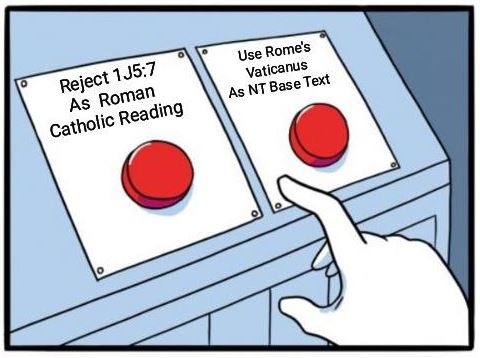


1 John 5:7 & Roman Catholic Provenance of Later Manuscripts

Introduction 

Recently, the Comma Johanneum (1 John 5:7) has been of particular interest in the text-critical discussion. I initially address some of the talking points here and Dr. Jeff Riddle here. Typically, advocates of the modern critical text appeal to the lateness of the manuscripts that have the passage to demonstrate why they believe it should be taken out of the text. Occasionally, the argument is made that it is a “Roman Catholic” reading, and should therefore be rejected by Protestants from a theological perspective. In this article, I will demonstrate why this is not a valid argument. It may have certain rhetorical value for those that are unfamiliar with Reformation history, but it is not devastating by any means as it pertains to the Comma Johanneum. Dr. Riddle makes several powerful observations in Word Magazine 149 (linked above) on this point, but I wanted to add several observations that should provide additional clarity. 

Reformation history is often challenging, because it is easy as modern Protestants to conflate the Jesuit stream of Catholicism with the whole of the western church leading up to and during the Reformation. What we have to remember, firstly, is that nearly everybody was a “Roman Catholic” leading up to the Protestant Reformation, with the exception of the Hussites and the Lollards and other groups that were driven underground until the 16th century by the inquisition.  Secondly, nearly all of the Protestant Reformers were Christian humanists – including Luther, Melanchton, Zwingli, and John Calvin. We have to be more careful when we hear the term “Roman Catholic Humanist,” because nearly all of the Reformers were “Roman Catholic Humanists” until they weren’t. In other words, the term “Roman Catholic Humanist” can be used to describe just about everybody worth mentioning by Protestants during the early 16th century. The humanist Renaissance is an important and necessary component of the Protestant Reformation itself, and to rebrand the term “humanist” into a pejorative based on modern definitions is simply irresponsible. 

Throwing the Baby Out With the Bathwater

The tendency of modern Protestants to reject anything and everything “Roman Catholic” from the late medieval period through the beginning of the Protestant Reformation is an unfortunate error. The humanist Reformers were not rejecting every part of the western church’s teaching, just the parts that they considered grave errors that departed from Scripture, such as the Roman Catholic doctrine of justification, the Lord’s Supper, authority of the pope and councils, and so forth. In rejecting the sum total of “Roman Catholic” theologians leading up to and during the Reformation, Protestants can mistakenly hand over some of the greatest theologians in church history, like Thomas Aquinas, to the post-Trent Roman Catholic church. The fact is, and many modern scholars such as Richard Muller have argued, that it is a shame to surrender the sum total of Medieval scholastic theology, because the Reformers didn’t. Again, the Reformers were Reforming what they considered to be grave errors of the Western church, not rejecting all of the theology that developed in the Western church outright. 

That said, I want to examine an argument against the Comma Johanneum, and evaluate the claim that a “Roman Catholic” provenance should cause Protestants to reject the extant manuscripts as inauthentic as a result. In the first place, the claim that the Comma Johanneum itself has a “Roman Catholic” provenance is rather disingenuous at the start. Dr. Riddle answers the question of “Do the late manuscripts of 1 John really have Roman Catholic provenance?” in Word Magazine 149, but I want to answer the question, “Even if they do have Roman Catholic provenance, does it matter?” The short answer is, no. 

Theologically speaking, the medieval scholastic schoolmen, to this day, provided some of the most clear and concise articulations of Theology proper and the Trinity. In today’s world of social Trinitarianism and other heterodox views of the Trinity, it is actually important that Protestants understand the value that the medieval scholastic theologians provided to the formulation of the doctrine of God. While the schoolmen certainly had their pitfalls, and the humanist reformers were outspoken about these errors, this is one area of Theology that modern Protestants should not simply lump in with “Roman Catholic” Theology. In fact, if modern Protestants completely reject the sum total of medieval scholastic theology, they lose a large piece of their own heritage as Christians. It is important to remember that the Roman Catholic church did not become corrupt overnight, and there were many, many faithful men within the Western church leading up to the Reformation, despite the errors that we all know about. God didn’t abandon His people for 1,000 years, as some seem to indicate. Just like with any beloved theologian of the past, it is a valuable skill to reject what is not Biblical, and benefit from what is Biblical. The fact is, that many of the Western theologians were quite critical of the immorality of Western bishops and Popes, and there were many forerunners to the Reformation who were outspoken against the doctrines we associate with Reformation era Rome.

In other words, it is important to have the discernment to know that 1) not all “Roman Catholics” leading up to and during the Reformation represent the thought of the Jesuits and 2) that many of the theologians casually called “Roman Catholic Humanists” were actually men who contributed greatly to the cause of the Reformation, even if they didn’t make a clean break with the Protestants. Erasmus of Rotterdam is a great example of this. Erasmus was one of the most effective polemicists against the wickedness of the Roman Catholic church during his day. He is famously credited with writing works such as “Julius Excluded From Heaven,” wherein he comically depicts the Pope being denied entrance to heaven. Upon seeing some of the more questionable decisions of Martin Luther, such as his influence on German nobility during the Peasant Revolt, Erasmus thought it better to try to Reform the church from the inside instead of causing chaos in the church. It is valuable to recognize the heterodoxy of Erasmus while also recognizing his contributions to the Reformation as well. Luther actually put a bad taste in the mouths of the Roman Catholic humanists who were trying to reform the church and were actually quite sympathetic to the reformers up to a point. Ultimately, this lead to Erasmus dying in isolation, effectively ostracized. It is easy to simply use the terms “Roman Catholic Humanist” as a rhetorical device, but this does disservice to Reformation history, and the contributions of the men who were simply trying to be faithful, despite their various errors. It is actually inconsistent to admit that the term “humanist” meant something different then as it does now, and also use it as a pejorative to discredit men like Erasmus.

There are four simple takeaways that I want to leave my reader with from this article. 

  1. Nearly everybody we call a Reformer today was Roman Catholic until they weren’t. In fact, pretty much everybody in the Western church was a “Roman Catholic” until the Reformation.
  2. Even those that did not break clean with the Protestants still had critiques of the Roman Catholic church – not everybody was a Jesuit
  3. Nearly everybody we call a Reformer today was a Christian humanist
  4. During the time of the Reformation, the doctrine of the Trinity as articulated by the schoolmen was actually a point of common ground between the Protestant Reformers and the Roman Catholic church

Conclusion

Since the support of the Received Text is a theological appeal, it would make sense that advocates of the Modern Critical Text would attempt to make a theological argument against various readings in it. It is actually the right approach, if you understand the Received Text position at all and wish to cast doubt on the historical Protestant text of Holy Scripture. The fact is, that the Protestant Orthodox remained in agreement with the Roman Catholic church on the point of the Trinity during the Reformation, and the medieval scholastic schoolmen still provide us with valuable contributions to Theology proper and can be benefited from greatly today. In other words, the so called “Roman Catholic” provenance of later manuscripts which contain 1 John 5:7 have no bearing on the textual discussion whatsoever. Especially considering the context of the time they received this reading. They, above anybody in our modern context, would have been especially in tune with sketchy provenance.

I’ll end this article with an appeal to common sense. Theological precepts are not a function of the axioms of the modern critical text. The only function a theological appeal has from a modern critical perspective is polemic, and is not productive if the goal is defending the text of Holy Scripture. It is strange that advocates of the modern critical text have decided to aim this polemic arm at the historical protestant text. It seems rather counterproductive, if the goal is to defend the Scriptures. In the case of the Comma Johanneum, the appeal to Roman Catholic provenance of later manuscripts of 1 John to advocate against the Comma are ultimately disconnected from Reformation history, and the goal of this article is to demonstrate that it is really not a meaningful argument. Again, I highly recommend Dr. Riddle’s Word Magazine 149, where he drives this point home well. Further, an appeal to provenance is rather curious, as nearly all of the preferred manuscripts of the modern critical text are without definitive provenance, and where the provenance of these manuscripts is inspected, the conclusions are that they possibly were produced by non orthodox sources. This is yet another reminder that it is not wise to throw stones in glass houses. See this quotation from Herman Hoskier as cited by Dr. Royse in Scribal Habits in Early Greek New Testament Papyri

“In the first place we do not believe that the scribe of B [Vaticanus] was a Christian. He seems to have been more or less a Western Unitarian.”

Jim Royse. Scribal Habits in Early Greek New Testament Papyri. 3. Bracketed material added.

So if those in the modern critical text camp really wish to appeal to provenance as a meaningful argument against a text, it may be wise to first take a look at the “earliest and best” extant manuscripts rather than a text that was considered orthodox by the Protestant church during the Reformation, whose provenance provides no negative context to the text at hand. This kind of appeal most importantly demonstrates the disconnect between evangelical advocates of the modern critical text and their history, if anything. For those that are discerning whether or not they wish to continue using the modern critical text or move over to the Received Text, this conversation may be enlightening for you. Note that when advocates of the modern critical text attempt to make theological arguments, it is for the purpose of proving a Scripture not authentic. The goal is to cast doubt on a reading which the historical Protestants have defended. Ironically, the arguments employed by modern critical text advocates against the Received Text are of Jesuit provenance. The purpose of which is to persuade Christians to adopt the axioms of modern textual criticism, which do not consider inspiration, preservation, or the Holy Spirit at all. Compare this with the polemics of those in the Received Text, who desire that Christians reject the notion that God has not preserved and delivered His Word. Simply looking at the outlook of each position is a great way to put the conversation in perspective. One side is arguing that Christians adopt the assumption that,

“We do not have now – in our critical Greek texts or any of our translations – exactly what the authors of the New Testament wrote. Even if we did, we would not know it.”

(Gurry & Hixson, Myths and Mistakes in New Testament Textual Criticism, xii)

The other side is arguing that God, “In His singular care and providence, has kept His word pure in all ages.” Take a stand on Scripture, Christian, and be blessed knowing that God has not abandoned His church. The fact stands that despite the confidence in modern textual scholars, they simply cannot prove that the Comma Johanneum (1 John 5:7) entered the manuscript tradition by way of the Latin tradition. There is nothing that prevents us from believing that God inspired this text, and preserved it in both Greek and Latin manuscripts.

A Crash Course in the Textual Discussion

Introduction

When I first started learning about the textual variants in my Bible, I had a great number of misconceptions about textual criticism. I thought myself rather educated on the matter because I had read the KJV Only Controversy twice and had spent hours upon hours watching the Dividing Line. Yet, when it came down to actually understanding anything at all about the matter, I realized I didn’t know anything. Even though I knew a lot of text-critical jargon, and could employ that jargon, much of the arguments I had learned were factually incorrect or misinformed. A comment on my YouTube channel earlier today demonstrated to me that many others are in the same boat I was in. 

The fact is,I couldn’t tell you why the Papyri were significant, or even how many Papyri were extant and what sections of the Bible they included. I couldn’t even name a proper textual scholar, except for maybe Bart Ehrman, but I thought he was just an angry atheist. I had heard that the CBGM was going to get us to a very early text form, but I couldn’t explain how or if that text was reliable. I knew that textual criticism was changing, but again, I didn’t know what those changes were or how they affected my Bible. There are a lot of downsides to getting your information from one or two sources, especially if those sources are simply interpreters of textual scholarship and not textual scholars themselves. The only thing that I had really adopted from the sources I had interacted with was confidence that I was on the right side of things, without really knowing why. I developed a list of questions that I wish somebody had asked me before I adopted the axioms of the Modern Critical Text, and perhaps they will be helpful for my reader.

  1. How did the Papyri finds impact the effort of textual scholarship?
  2. Is the concept of “text-type” a driving factor in the current effort of textual scholarship? 
  3. Which manuscripts are primarily used as a “base text” of the modern critical text as it is represented in the NA27 and 28? 
  4. What is the Editio Critica Maior (ECM)?
  5. Which textual scholars are involved in creating the Editio Critica Maior (ECM)? 
  6. What is the Initial Text, and how is it different than the Original?
  7. What is the difference materially between the Received Text and the Modern Critical Text?
  8. What is the CBGM, and how is it impacting modern Greek texts and Bible translations? 
  9. Which scholars are contributing to the current effort of textual scholarship, and what are their thoughts on the CBGM and ECM? 
  10. What do the scholars who are editing the modern Greek New Testament as it is represented in the Nestle-Aland/UBS platform think of the text they are creating? 
  11. What is the TR?

This “quiz” of sorts is a good litmus test as to whether or not you are up to date on the current trends in textual criticism. 

Answer Key

  1. The Papyri, while initially exciting, did not yield the kind of fruit that many would have hoped. In the first place, they disproved Hort’s theory that Codex Vaticanus was earliest text, because the Papyri included readings that were not extant in the Alexandrian manuscripts, which were called “Earliest and Best” all throughout the 20th century and even still today by some. This means that the Papyri do not vindicate the Alexandrian text form as “earliest”, and in fact, they prove that there were other “text forms” circulating at the same time. While the Papyri may be helpful in establishing that the Bible existed prior to the fourth century, every single Christian, in theory at least, believes this to be true regardless of the Papyri. Christian apologetics were done successfully well before the discovery of the Papyri. The Christian faith is one which believes that the eternal Logos became flesh in the first century, lived a perfect life, died on a Roman cross, was dead for three days, rose again on the third day, appeared to a group of disciples and a multitude of others, then ascended to the right hand of the Father. This is established without the Papyri, as the Bible is not established based on the Papyri. Further, there are less than 150 Papyri manuscripts, and many of them are scraps. We could not construct a whole New Testament with the Papyri manuscripts. So while the Papyri may to some serve some sort of apologetic purpose, their value as it pertains to actually creating a Greek New Testament is much less significant than other later New Testament data. 
  1. Due to the pre-genealogical coherence component of the CBGM, the concept of text-types has largely been abandoned by textual scholars, except for perhaps the Byzantine text-type, which is largely uniform. Due to algorithmic analysis driven by the power of electrical computing,  modern critical methods have demonstrated that the manuscripts formerly classed in the Alexandrian, Western, and Cesarean text families do not share enough statistical similarity to be properly called a text-family. Further, the current text-critical scholars have adopted a different method, which focuses primarily on evaluating individual verses, or readings, rather than manuscripts as a whole. So not only are the manuscripts formerly classed into the Alexandrian, Western, and Cesarean text families not families, the concept of text families is not necessarily being used in the current methodology. 
  1. The two manuscripts which serve as a “base-text” for the NA/UBS platform are Codex Vaticanus (B), and Codex Sinaiticus (Aleph). Significant variations between the Received Text and the Modern Critical Text are typically the result of prioritization of these two manuscripts over and above the readings found in the majority of manuscripts or other manuscripts. This is shifting as the concept of text-types is being retired, but the text as it exists in modern Bibles generally reflects the text form of just two manuscripts. As the CBGM is implemented, this may cause certain Alexandrian readings to be rejected, but as it stands, modern Greek Texts and Bibles heavily favor the two manuscripts mentioned above. These two manuscripts do not belong in the same family, which is to say that they likely do not share one common ancestor or ancestors. It is possible that perhaps that they share a cousin manuscript, but even that is speculative. 
  1. The Editio Critica Maior (ECM) is a documented history of the Greek New Testament up to about 1,000AD which considers Greek manuscripts, translations, and ancient citations of the New Testament. The ECM also provides information on the development of variants according to the analysis of the editors. The first edition was published in 1997 and is slated to be finished by 2030. The ECM is not necessarily a Greek New Testament per se, but rather a history of how the text is said to have evolved in the first 1,000 years of the church. This means that it excludes copies made from manuscripts after 1,000AD that predate 1000AD. For example, if a manuscript was copied in 1300AD from a manuscript created in 500AD, the readings from the 1300AD copy will not be considered, despite preserving very old readings. The main text printed in the ECM contains the readings which are said to be the earliest, though there are many places where the editors of the ECM are split in determining which reading came first. Due to these split readings, the ECM functionally serves as a dataset, which the user can individually evaluate to select which readings they believe to be the earliest. A current weakness of the ECM is that it does not consider all of the extant data, and it is yet to be seen if the final product in 2030 will incorporate all extant New Testament witnesses. As it stands, it is an incomplete history of the New Testament, despite being the largest critical edition produced to date. 
  1. It is difficult to find all of the men and women working on the ECM, but some of the scholars who have worked on, or are working on the ECM are Holger Strutwolf, DC Parker, and Klaus Wachtel. The Institute for New Testament Textual Research in Munster is overall responsible for the project. The ECM is supported by the Union of German Academies of Sciences and Humanities. 
  1. The conversation of the Original text vs. the Initial Text is still one being hotly debated amongst textual scholars, but Dr. Peter Gurry defines it as, “The ECM editor’s own reconstructed text that, taken as a whole, represents the hypothetical witness from which all the extant witnesses derive. This hypothetical witness is designated A in the CBGM, from the German Ausgangstext, which could be translated as “source text” or “starting text.” The relationship of the initial text to the author’s original text needs to be decided for each corpus and by each editor; it cannot be assumed” (Peter Gurry, A New Approach to Textual Criticism, 136). Simply put, the Initial Text is the “as far back as we can go text.” It is up to the editor, or perhaps the Bible reader, whether or not that Initial Text represents what the writers of the Bible actually wrote. It is important to keep in mind that the Initial Text is likely to favor texts from a particular region. That is to say, that the Initial Text produced by scholars is only one of many potential Initial Texts. Despite the fact that many are optimistic regarding the Initial Text, the fact stands that there are many readings in the ECM which the editors are split on which reading is initial. That means there is no consensus on what the Initial Text is, or what it will be. How this will be determined has yet to be seen. I comment on the discussion here and here
  1. The difference between the Received Text (TR) and the Modern Critical Text (MCT) is significant. The MCT is at least 26 verses shorter, as it excludes the ending of Mark (Mk. 16:9-20), the Pericope Adulterae (Jn. 7:53-8:11), the Comma Johanneum (1 Jn. 5:7), John 5:4, Acts 8:37, and Romans 16:24. There are also a number of places where the readings are different, such as John 1:18, and 1 Tim. 3:16. There are also places in the MCT like 2 Peter 3:10 where the readings has the opposite meaning as the TR. Many advocates of the MCT are quick to point out that the TR does not have Greek manuscript support for Revelation 16:5, but the MCT also has readings that do not have Greek manuscript support, like 2 Peter 3:10, mentioned above. This does not mean that the verses cannot be supported, just that it is rather hypocritical that many MCT advocates demand extant manuscript support when there were manuscripts available at one time that may have had a reading. In many of the doctrinally significant places where the MCT and TR differ, the TR contains readings found in the majority of manuscripts, whereas the MCT represents a small minority, and in some places, just two manuscripts (Mk. 16:9-20). In other places, the TR contains minority readings, though I argue that these minority readings can be substantiated by the consensus of commentaries, theological works, and Bible translations throughout the history of the church. In any case, the amount of variants in the within the TR tradition is minute compared to the amount of variants that must be reconciled within the MCT tradition. 
  1. The Coherence Based Genealogical Method (CBGM) is “a method that (1) uses a set of computer tools (2) based in a new way of relating manuscript texts that is (3) designed to help us understand the origin and history of the New Testament Text” (ibid. 3). The CBGM uses statistical comparison to determine how closely related two witnesses are to each other, and then text-critics evaluate that comparison to determine which reading potentially came first in the transmission history of the text. This is the method that is primarily being used to construct the ECM. To see a basic overview of the method, please refer to this video, which is a thoughtful and helpful examination of the CBGM. I comment on the CBGM more here.
  1. The scholars that are using the CBGM and creating the ECM have varied opinions on what is being constructed. Men like Eldon Epp and DC Parker do not believe that the ECM has anything to say about the original, or authorial text of the New Testament. Others are more optimistic, such as Dirk Jongkind and Peter Gurry. As it stands, it has yet to be demonstrated how the ECM can definitively say anything about the original or authorial text, as the methods of the CBGM do not offer this sort of conclusion. Further, it has yet to be shown how a text with split readings can be said, in any meaningful way, to represent one unified Initial Text, let alone an original. That is to say, that the ECM contains the potential for multiple Initial Texts. The problem of split readings in the ECM has yet to be addressed adequately as far as I know. 
  1. The scholars creating printed Greek texts such as the NA/UBS platform do not believe they are creating original texts. They are simply creating printed texts that serve as a tool in translation and exegesis. The editors are typically disinterested in speaking to whether this text represents the authorial text, that is up to the user of the printed edition. This is evident in the fact that the 28th edition of the Nestle-Aland text and the 5th edition of the United Bible Society text are not a final text. Due to the ongoing creation of the ECM, these printed Greek texts are going to change, even optimistic scholars, such as Dr. Peter Gurry, comment that these changes “will affect not only modern Bible translations and commentaries but possibly even theology and preaching” (ibid. 6).
  1. The Received Text (TR), is the form of the Greek New Testament as it existed during the first era of printed Greek Bibles during the 16th century after the introduction of the printing press in Europe. Up to that point, all books were hand copied. There is not one “TR”, per se, but rather a corpus of Greek Texts which are generally uniform. The places of variation between the TR are minor when the significance of these differences is considered. The opinion of textual scholar Dr. Edward F. Hills was that these variations amount to less than 10. High orthodox theologians such as Turretin considered such variations to be easily resolved upon brief examination. This was the Greek text that the Westminster Divines considered “Pure in all ages” and is the text platform that the Reformed and Post-Reformation Divines used in their commentaries and theological works from the middle of the 16th century up to the higher critical period when Hort’s text (Based on Vaticanus, generally the same text that is used for the ESV) was introduced as an alternative. There are varying views on what “the” TR is, but across all of the printed editions of the Received Text corpus, the differences are so minute that it can be considered the same Bible nonetheless. Modern debate tactics have introduced much confusion into the definition of “the’ TR, but the fact stands that this sort of question was not a problem to the men who used it to develop protestant theology up to the higher critical period. Adherence to the TR is based on the vindication of readings by the use of such readings by the people of God in time over and above extant manuscript data, which cannot represent all of the manuscripts that have ever existed, since a great number have been lost or destroyed.

Conclusion

Prior to entering into the Textual Discussion, I think it wise that Christians are up to date on not only the updated jargon, but also the information that underlies the jargon. If one wants to argue that the Papyri are definitive proof of one text being superior to another, he should be ready to substantiate that claim by demonstrating how the readings of the Papyri have impacted modern text-critical efforts. In the same way, if somebody wishes to stake a claim on the CBGM, it should also follow that one should be ready to demonstrate how this method has proved one conclusion or another. Simply saying that the Papyri and the CBGM have “proven” a particular text right or wrong is simply an assertion that needs to be substantiated. It may be the case that the claim is correct, but it is important that we hold ourselves to the same standard an 8th grade math teacher might hold us to, and “show your work.” The fact stands that a Bible cannot be constructed from all of the Papyri and the CBGM has introduced a “slight increase in the ECM editors’ uncertainty about the text, an uncertainty which has been de facto adopted by the editors of the NA/UBS” (ibid. 6). 

It is easy to get caught up in conversations on textual variants and the scholarly blunders of Erasmus, but these discussions do not come close to addressing the important components of the Textual Discussion. An important reality to consider when discussing variants from an MCT perspective is that the modern critical text is not finished, and the finished product is not claiming to be a stable or definitive text. The opinions on a variant may change in the next ten years, and new variants may be considered that have been ignored throughout the history of the church. One might make a case for why Luke 23:34 is not original, but the fact is that it is impossible to prove such a claim by modern critical methods without the original to substantiate the claim against. Even in the case of 1 John 5:7, which is admittedly a difficult verse to defend evidentially, it cannot be proven that other manuscripts contemporary to Vaticanus and Sinaiticus excluded the passage, because those manuscripts are no longer extant. Since it is well known that other Bibles with different readings existed at the time of our so called earliest manuscripts (because of the Papyri!), we can at least say with confidence that these two manuscripts do not represent what all of the Bibles looked like at that time. That is to say, that those who argue vehemently for Bibles which closely follow these two manuscripts are simply putting their faith in the unprovable claim that the other contemporary manuscripts did not have the readings that explode into the manuscript tradition shortly after and even minority readings that made it into the TR. Some people, like James Snapp, have developed entire textual positions which recognize this problem, which I consider a sort of mediating position between the Received Text and the Modern Critical Text. Unlike many of the MCT advocates, James Snapp is more than willing to show his work.  

In any case, it is high time that the bubble of Codex B is pricked. Times have changed, and even the most recent iteration of modern text-criticism has supposedly done away with Hort’s archaic theories. It may be time that Christians stop appealing to the Papyri and the CBGM without actually understanding what those two things are, and instead pick up some of the literature and become acquainted with what has changed since Metzger penned his Text of the New Testament. In my opinion, Snapp has answered many of the questions that modern textual scholars are unwilling to answer with his Equitable Eclecticism. While I believe his position still faces the same epistemological problems as the ECM and the CBGM, it certainly is an upgrade from the MCT. I hope that this article has helped people understand the effort of modern textual criticism better, and perhaps even sparked interested in investigating the information themselves. 

Sources for Further Reading on Modern Textual Criticism

D.C. Parker, editor of the ECM for the Gospel of John

Peter Gurry’s Introduction to the CBGM

Peter Gurry and Elijah Hixson’s Latest Book

The Latest, Authoritative Work on the Pericope Adulterae (Jn. 7:53-8:11)

Sources for Further Study on the Received Text Position

Audio from the Text and Canon Conference 

Audio from Dr. Jeff Riddle’s Word Magazine

Memoirs of an ESV-Onlyist: Reflecting on the Text and Canon Conference

Introduction

On Reformation weekend, a small conference was held in Atlanta, Georgia called The Text and Canon Conference which focused on offering a clear definition of what it means when people advocate for the Masoretic Hebrew and Received Greek text. For those that are not up to date with all of the jargon, the Masoretic Hebrew text is the only full Hebrew Old Testament text available, and the Greek Received Text is the Greek New Testament which was used during the Protestant Reformation and Post-Reformation period. At the time of the Reformation, the Bibles used the Masoretic Text and Received Text for all translational efforts. Bibles produced in the modern era use the Masoretic Text as a foundation for the Old Testament, but frequently use Greek, Latin, and other translations of the Hebrew over the Masoretic text. Modern Bibles also utilize a different Greek text for the New Testament which is commonly called the Modern Critical Text. As a result of these differences, the Bibles produced from the text of the Reformation are different in many ways from the Bibles produced during the recent years.  

One of the major focuses of the conference was to demonstrate that it is still a good idea, and even necessary, to use a Reformation era Bible, or Bibles that utilize the same Hebrew and Greek texts as the Reformation era Bibles. The key speakers, Dr. Jeff Riddle and Pastor Robert Truelove, delivered a series of lectures which demonstrated the historical perspective on the transmission history of the Old and New Testaments and presented a wealth of reasons why the Reformation era Hebrew and Greek texts are still reliable, even today. I will be writing a series of articles which cover some of the key highlights of the conference. In this article, I want to explain why I think this conference was necessary, and also to detail the series of events which led me to attending this conference. 

Why Was the Text and Canon Conference Necessary?  

There are two major reasons that I believe the Text and Canon conference was necessary. The first is that many Christians do not believe that there is any justifiable reason to retain the historical text of the Protestant church. The second is that many Christians are not fully informed on the state of current text critical efforts. Due to this reality, lectures delivered at the Text and Canon conference provided theological and historical reasons which supported the continued use of the Reformation era Hebrew and Greek texts, as well as offered information on the current effort of textual scholarship. An important reality in the textual discussion is that the majority of Christians do not have the time and in many cases, the ability to keep up to date with all of the textual variants and text-critical methodologies that go into making modern Bibles. There is a great need in the church today for clear articulations of the history of the Bible, as well as accessible presentations on how modern Bibles are produced. The Text and Canon conference, in part, met this need, as well as offered many opportunities for fellowship and like-minded conversation. Prior to launching into a series of commentary on the conference, I thought it would be helpful to share my journey from being a modern critical text advocate to a Traditional Text advocate. 

From the 2016 ESV to the Text and Canon Conference

Prior to switching to a Reformation era Bible, I began to discover certain realities about the modern efforts of textual criticism which caused me to have serious doubts as to whether or not the Bible was preserved. I had a hard time reconciling my doctrine of inspiration and preservation with the fact that there is an ongoing effort to reconstruct the Bible that has been in progress for over 200 years. These doubts increased when I discovered that not only had the methods of text-criticism changed since I was converted to Christianity over ten years ago, but that the modern critical text would be changing more in the next ten years. I began to read anything I could get my hands on to see if I could figure out more information on the methods that were responsible for creating the Bible I was reading at the time. When I began this process of investigation, I had just finished my cover-to-cover reading plan of the new 2016 ESV. At first, I was attempting to simply understand the methodology of the modern critical text with the assumption that a better understanding of it would help me defend the Scriptures against the opponents of the faith. The process quickly became a search for another position on the text of Scripture. This is due to some of the more alarming things I learned in my investigation of modern critical methods. There are six significant discoveries I made when investigating the current effort of textual criticism that I would like to share here. These six discoveries led me from being a committed ESV reader to a committed KJV reader.  

The first discovery that sent me down a different path than the modern critical text was when I investigated the manuscript data supporting the removal of Mark 16:9-20 in my 2016 ESV. The other pastor of Agros Church, Dane Johannsson, had called me to tell me about some information he learned about the Longer Ending of Mark after listening to an episode of Word Magazine, produced by Dr. Jeff Riddle. Up to this point, I had heard many pastors that I trusted say that the manuscript data was heavily in favor of this passage not being original. My Bible even said that “Some of the earliest manuscripts do not include this passage”. I was seriously confused when I found out that only three of the thousands of manuscripts excluded the passage, and only two of them are dated before the fifth century. This made me wonder, if all it took was two early manuscripts to discredit the validity of a passage in Scripture, what would happen if more manuscripts were found that did not have other passages that I had prayed over, studied, and heard preached? If a passage that had thousands of manuscripts supporting it could be delegated to brackets, footnotes, or removed based on the testimony of two manuscripts, I realized that this same logic could be easily applied to quite literally any place in my Bible. All that it would take for other passages to be removed would be another manuscript discovery, or even a reevaluation of the evidence already in hand.  

The second discovery was the one that fully convinced me to put away my 2016 ESV and initially, pick up an NKJV. At the time of this exploration process I was utilizing my Nestle-Aland 28th edition and the United Bible Society 5th edition in my Greek studies. I was still learning to use my apparatus when I learned what the diamond meant. In the prefatory material of the NA28, it states that the diamond indicates a place where the editors of the Editio Critica Maior (ECM) were split in determining which textual variant was earliest. That meant that it was up to me, or possibly somebody else,  to determine which reading belonged in the main text. This is a reality that I would have never known by simply reading my ESV. I discovered that there were places where the ESV translators had actually gone with a different decision than the ECM editors, like 2 Peter 3:10, where the critical text reads the exact opposite of the ESV. This of course was concerning, but I wasn’t exactly sure why at the time. I figured there had to be a good reason for this, there were thousands of manuscripts, after all. I began investigating the methodology that was used to produce these diamond readings, and learned that it was called the Coherence Based Genealogical Method (CBGM). I quickly found out that there was not a whole lot of literature on the topic. The two books that I initially found were priced at $34 and $127, which was a bit staggering for me at the time. It was important for me to understand these methods, so I ended up at first purchasing the $34 book. It was what I discovered in this book that heavily concerned me. Due to the literature on the CBGM being relatively new, and possibly too expensive for the average person to purchase, I had a hard time finding anybody to discuss the book with me. It was actually the literature on the CBGM that motivated me to start podcasting and writing on the issue. If I couldn’t find anybody to discuss this with, it meant that nobody really knew about it.   

The third discovery was the one that convinced me that I should start writing more about, and even advocating against, this new methodology. This was the methodology that was being employed in creating the Bible translations that all of my friends were reading, and that I was reading up until switching to the NKJV. It’s not that I “had it out” for modern Bibles, I figured that if these discoveries had caused so much turmoil in my faith, they would cause others to have similar struggles. Most of my friends knew nothing about the CBGM, just that they had heard it was a computer program that was going to produce a very accurate, even original, Bible. After reading the introductory work on the method, I knew that what I heard about the CBGM was perhaps too precipitated. Based on my conversations with my friends on textual criticism, I knew that my friends were just as uninformed as I was on the current effort of textual scholarship. It wasn’t that I thought I was the first person to discover these things that motivated me to start writing,  but the fact that myself and all of my friends were not aware of any of the information I was reading. Up to that point in my research, I was under the assumption that the goal of textual criticism was to reconstruct the original text that the prophets and apostles had penned. I even thought that scholars believed they had produced that original text which I was reading in English in my ESV. I found out that this was not the case for the current effort of textual scholarship. I learned that the goal of textual criticism had, at some point in the last ten years, shifted from the pursuit of the original to what is called the Initial Text. In my studies, I realized that there were differing opinions on how the Initial Text should be defined, and even if there was one Initial Text. In all cases, however, the goal was different than what I thought. It did not take me long to realize the theological implications of this shift in effort. At the time, I fully adhered to both the London Baptist Confession of Faith 1.8, as well as the Chicago Statement on Biblical Inerrancy. It was in examining the Chicago Statement on Biblical Inerrancy against the stated goals of the newest effort of textual criticism that made me realize there were severe theological implications to what I was reading and studying.  

The fourth discovery was the one that made me realize that the conversation of textual criticism was not only about Greek texts and translations, it was about the doctrine of Scripture itself. At the time I believed that the Bible was inspired insofar as it represented the original, and the original, as I found out, was no longer being pursued. The original was no longer being pursued, I learned, because the majority, if not all of the scholars, believed it could not be found, and that it was lost as soon as the first copy of the New Testament had been made. There are various ways of articulating this reality, but I could not find a single New Testament scholar who was actually doing work in the field of textual scholarship who still held onto the idea that the original, in the sense that I was defining it, could be attained. Even Holger Strutwolf, a conservative editor of the Modern Critical Text, seems to define the original as being as “far back to the roots as possible” (Original Text and Textual History, 41). This being the case, if the current effort of textual criticism was not claiming to have determined the original readings of the Bible, than my doctrine of Scripture was seemingly vacuous. If the Bible was inspired insofar as it represented the original, and there was nobody able to determine which texts were original, my view of the Bible was that it wasn’t inspired at all. At the bare minimum, it was only inspired where there weren’t serious variants. In either case, this reality was impossible for me to reconcile. I then sought out to discover how the Christians who were informed on all the happenings of textual criticism explained the doctrine of Scripture in light of this reality. I figured I wasn’t the first person to discover this about the modern text-critical effort, so somebody had to have a good doctrinal explanation. 

The fifth discovery was the one that made me realize that I did not have a claim to an inspired text, if I trusted in the efforts of modern textual criticism. In my search for faithful explanations of inspiration in light of the current effort of textual criticism, I did not find anything meaningful. In nearly every case, the answer was simply one of Kantian faith. Despite the split readings in the ECM and the abandoned pursuit of the original, I was told I had to believe it was preserved. Even if nearly every textual scholar was saying that the idea of the “original” was a novel idea from the past, or simply the earliest surviving text, I had to reconcile that reality with my theology. One of the answers I received was that the original text was preserved somewhere in all of the surviving manuscripts, and that there really was not any doctrine lost, no matter which textual variants were translated. This is based, in part, on an outdated theory which says that variants are “tenacious” – that once a variant enters the manuscript tradition it doesn’t fall out. This of course cannot be proven, and even can be shown to be false. Another answer I found was that all of the surviving manuscripts essentially taught the same exact thing. This would have been comforting, had I not spent time using my NA28 apparatus and reading different translations. I knew for a fact that there were many places where variants changed doctrine, sometimes in significant ways. Would the earth be burnt up on the last day, or would it not be burnt up? Was Jesus the unique god, or the only begotten Son? The answers I received simply did not line up with reality. I had no way of proving which of the countless variants were original. When I discovered this, I finally understood the position of Bart Ehrman. He, like myself, had come to the conclusion that the theories, methods, and conclusions which went into the construction of the modern critical text told a story of a Bible that really wasn’t all that preserved. 

The sixth and final discovery I made, which did not necessarily happen in chronological order with the rest of my discoveries, was that there were several other views of textual criticism within the Reformed and larger Evangelical tradition. Prior to beginning my research project, I had read The King James Only Controversy, which led me to believe that there were really only two views on the text – KJV Onlyists and everybody else. I discovered that this was the farthest thing from reality and a terrible misrepresentation of the people of God who held to these other positions. The modern critical text was not a monolith, and I did not need to adopt it to defend my faith, or have a Bible. In fact, I knew that there was no way I could defend my faith with the modern critical text. In my research, I even discovered countless enemies of the faith who used the modern critical text as a way to disprove the preservation of Scripture. Various debates against Bart Ehrman that I watched demonstrated this fact clearly. I learned that even within the camp of modern textual criticism, there were people who did not read Bibles translated from the modern critical text. There were even people who disagreed on which readings were earliest within the modern critical text. There were people who adopted the longer ending of Mark and the woman caught in adultery who also did not read the KJV. There were also people who believed that the Bible was preserved in the majority of manuscripts, in opposition to other positions which say that original readings can be preserved in just one or two manuscripts. I also discovered the position I hold to now, which says that the original text of the Bible was preserved up to the Reformation, and thus the translations made during that time represent that transmitted original. This ultimately was the position that made the most sense to me theologically, as well as historically. I realized that the attacks on the TR, which often said that it was only created from “half a dozen” manuscripts, was not exactly meaningful, as the modern critical text often makes textual decisions based on just two manuscripts. In any case, the conversation of textual criticism was much more nuanced and complex than I had believed it to be. 

Conclusion

I can only speak for myself as to how my discoveries affected my faith. It is clear that many Christians do not have a problem with a Greek text that is changing, and in many places, undecided. In my case, I was told to take a Kantian leap of faith to trust in this text. In my experience, most of the time people simply are unaware of the happenings of modern textual scholarship. It is not that I have any special knowledge, or secret wisdom, I simply had the time and energy and opportunity to read a lot of the current literature on the latest methods being employed in creating Bibles. One thing that has motivated me to be so vocal about this issue is the reality that most people simply are uninformed on the issue, like myself at the time of starting my research project. Due to one reason or another, the information on the current methods is difficult to access for many, and even more simply do not know that anything has changed in the last 20 years. My gut tells me that if people were simply informed more on the issue, they might at least consider embarking on a research project like I did. The fact is, that many scholars and apologists for the critical text are insistent on framing this discussion as “KJV Onlyism against the world”, and it is apparent that it has been effective. Despite this, it was not my love for tradition or an affinity for the KJV that led me to reading it. In fact, I was hesitant to read it as a result of all the negative things I had heard about it. Primarily,it was my discoveries regarding the state of modern textual criticism that led me to putting down my ESV and picking up an NKJV, and then finally a KJV. 

I thought it would be helpful to detail my discoveries which led me to the position I hold now on the text of Scripture. I will be writing more articles commenting on what I consider to be the more important points of the conference. Hopefully my commentary can serve to give you, the reader, more confidence in the Scriptures, and to share some of the important information presented at the Text and Canon conference.  

Putting the Conversation in Perspective

Introduction

It may be difficult for many people to see the relevance of the textual discussion. This is often because it is rare that a positive case is made for the modern critical text.The majority of exposure people get to this conversation from a modern critical text position are simply polemics and a healthy dose of pejoratives. The problem with this is that these methods fail to offer a reason to believe that the modern critical text is the best. Simply saying the TR is awful and shouldn’t be used actually introduces far more problems than it solves. From a practical standpoint, if the Masoretic Hebrew text and the Received Greek text is not viable for use in the church, then not only was the Protestant religion sparked and built on a bad Bible, but there is an unfinished Bible for today’s church. It is important to clarify that I am not saying that people who adopt the modern critical perspective cannot be saved or cannot benefit from modern translations. I myself read through the Bible for the first time using an NIV. What I am saying is that a “mere Christianity” approach should not be adopted for the Bible we use. As Christians, we should be concerned with every jot and tittle, not the bare minimum it takes for somebody to be saved. That being said, I want to explain why somebody who found great comfort in the NIV in the early years of his Christian walk now reads a traditional Bible. If the last book you read on text-criticism was The Text of the New Testament in seminary, things have changed…a lot. Let’s take a step into the mindset of a modern critical text advocate for a moment here. The justification for adopting the modern critical text requires three main assumptions.

  1. The Received Greek Text does not represent the earliest manuscripts, and therefore represents a New Testament that was corrupted by well-meaning Christians over time
  2. The Masoretic Hebrew Text does not represent the original manuscripts as it has been corrupted by Jews seeking to diminish the deity of Christ
  3. The modern critical methods, and thus the modern critical text, are better than the previous text and should be used over and above the traditional text of the protestant church due to this orthodox and Jewish corruption of the Scriptures

An unfortunate side effect of advocating against the historical text of the Protestants is that the validity of the Bible is undermined as a whole. If the Masoretic Text has not been kept pure, which Hebrew text should be translated from? Typically the Septuagint is offered. There are two main problems with this. 1) There isn’t one “Septuagint” and 2) the confessions affirm against using translations as the ultimate rule of faith. Further, if the Received Text is not the New Testament, then the people of God have been woefully deceived. There are two ways to look at this deception. In the first place, if the Received Text was a strange, historical phenomenon where the people of God chose manuscripts that nobody had ever used in history, then the church was deceived for hundreds of years. This is in essence what is being claimed when somebody says, “This reads in a fashion unknown to the Christian tradition for a full 1,500 years.” If it is the case that the manuscripts used in the Reformation era printed texts represented the “most ancient copies”, as they claimed, then the church was deceived since the early church. In advocating for the modern critical text, there is a significant theological problem introduced that cannot be resolved without arguing for a total corruption of the text. 

More Questions Than Answers

If the theories of textual scholars are correct, the actual Bible is preserved partially in a small minority of manuscripts from the third and fourth centuries. The vast majority of manuscripts, according to modern scholarship, are the product of a well-meaning corruption by Christians to solidify doctrine, add beloved pericopes, and correct grammar mistakes. No matter how somebody spins it, God not only let his church and the Jews corrupt the Scriptures, but then allowed them to believe that those corruptions were inspired. In simple terms, there is no continuity in the preservation of God’s Word from a modern critical text perspective. The BIble was lost for a time, and now needs to be recovered. The text existed in the early church, became corrupted by the believing people of God and the Jews for a large chunk of church history, and resurfaced in the modern period for use by all in a small amount of neglected manuscripts and some versions of the Septuagint where doubt is cast on the Hebrew. 

The basic argument that is presented by the Confessional Text position is that the Bible was preserved going into the medieval and Reformation period, and that the text-critical work done in that period used those preserved manuscripts. If the assumption is that God preserved His Word, it would make sense that the general form of manuscripts used by the church would be most abundant, as they were used the most. Manuscripts that were later found in libraries, caves, and barrels sat collecting dust for a reason. Therefore the text-critical effort of the Reformation period was one of printing versions of the manuscripts which were considered best during that time. The problem that many have with this perspective is that the Reformation era text is often compared against the modern critical text with the assumption that the MCT is representative of the authorial, or original text. 

Yet a significant problem with this perspective is that it cannot be proven, or demonstrated with any level of confidence from an evidentiary standpoint. This is made evident in the fact that the theory of using text families to get back to the original text has been mostly abandoned. Instead, the effort of modern textual scholarship has shifted from finding the true authorial text to the hypothetical initial text. This is the major shift that occurred from the time of the Hort-Metzger era. Since the text that the people of God used during the Reformation period has been written off as a corruption, the only thing left to do is try and reconstruct the text that existed before that happened. This is more or less the current effort of the Editio critica maior. Instead of using text families, the current method is examining individual variant units and trying to determine which variant gave birth to the rest of the readings found in later manuscripts. No matter how thorough this analysis is, there will never be a way to determine if the earliest reading represents the original reading, or if that reading is even the earliest. This is the biggest limitation of the CBGM. There will never be a method that can span the historical gap between the authorial text and the initial text. In reality, this initial text will simply represent something similar to one version of the Bible from the third or fourth century that the people of God didn’t use universally. This is clearly shown in that the extant third and fourth century manuscripts do not represent the majority text or the Reformation era text. 

To put this in perspective, there are eight (P45, P46, P47, P66, P72, P75, Aleph, B, EDIT: Manuscript Clusters Tool is not linking properly. Type in Manuscript Name to use) significant manuscripts from before the fifth century that represent the text form which is called “earliest and best” in textbooks and modern bibles. Only two of these are complete bibles. The most complete of these manuscripts do not agree enough with each other to be related directly, which means that they did not descend from one uniform manuscript tradition. That means that the origin of these manuscripts will forever be a gray area to some extent. 

 Let me paint a picture that may help you understand what this means. Imagine you find a stack of nearly six thousand bibles. A handful of those bibles are extremely old, but not used very much so they are still able to be handled and examined. These older bibles have abrupt readings, omitted verses, more variants between the synoptic passages in the gospels, and have a great number of difficult grammatical constructions which take some effort to understand. They look different from the rest of the bibles, which have better grammar, less omitted passages, and more harmony in the readings. These handful of bibles are older, however, so you determine that they are the best. Since the majority of the bibles have a number of readings in the New and Old Testament that disagree with these older bibles, you determine that the majority of the bibles are wrong. You devise a theory that the original bible looked like the minority of older bibles. You make it your life’s mission to ensure that the majority of bibles are not used anymore, and 120 years later, the majority of churches are using the bible you’ve determined to be earliest and best. A small minority of churches still use the rejected bible, but are mocked and ridiculed for reading it. Those who read the newly declared oldest bibles ensure that these people are called “traditionalists” so that everybody knows they are wrong for not adopting the new bible. You devise pejorative terms like “New Bible Onlyists” to further scorn people for not adapting to the times. The majority of bibles are said to have been proven to be corrupt, so the division between the two camps becomes wider. There is only one problem – in the 120 years that the church adopted this new bible, nobody has been able to prove that the original claim was correct. In fact, there is an increasing amount of evidence which demonstrates that that claim was not correct at all. Instead of rejecting these old bibles, a new method is devised to prove the original theory. The church, mostly unaware of this, continues to read these newly adopted bibles and viciously attack those that have not adopted the new standard.

Conclusion

The period of time from the authorial event of the New Testament to the Reformation period is the most significant when it comes to the textual discussion. There are two narratives of the transmission history during this time. The first is that the Bible was kept pure in the manuscript tradition until the Reformation period, where the text-critical efforts of that time took those preserved manuscripts, edited them into printed editions, and made Bibles from them. The second is that by the third and fourth century, the manuscript tradition began to evolve as believing Christians smoothed out the grammar, added beloved pericopes, and expanded verses to make the Christology of the Bible more clear. In the second narrative, the Jews were also hard at work corrupting the Hebrew Scriptures so that by the time the modern period came around, there was not a single Hebrew text which represented the authorial text. 

This conversation is not about the TR or the modern critical text, it is about the narrative of preservation. If God preserved the Bible into the Reformation period, than the work done during that time was the final effort needed. The only reason to believe that an ongoing text-critical effort is required is if the first effort used a corrupted version of God’s Word in the Hebrew and Greek. Since the source material of the Reformation period needs to be considered corrupted to justify the modern effort, additional methods must be employed which extend beyond the capabilities of the extant data. These methods include constructing hypothetical archetypes of the earliest texts and correcting the Hebrew with Greek versional readings. Despite the best efforts of modern textual scholarship, the results of these methods cannot “prove” anything regarding the original text. The strongest testimony to the authorial text will always be the witness of the people who used those texts in time. Christians can indeed have confidence in their Bible, but I argue that the modern critical methodology cannot provide that confidence. If the Bible was preserved, it was preserved up to the time of the first text-critical effort. That effort produced the Bibles that sparked the Protestant Reformation and the largest Christian revival in the history of the World. The theological works which the modern church stands on were developed from this text, and Christians still stand on that theology, especially the confessionally Reformed. At the very foundation of this conversation is two different narratives, and two different methodologies. Neither of these narratives can be proved purely by extant manuscript data if the manuscript data is viewed agnostically. The real question that must be answered by Christians is, “Did God preserve His Word into the middle period and Reformation period, or not?” If manuscripts that represent the minority of the extant data are rejected, than the perspectives of the Reformed are clear as day. They believed the Bible had been preserved in both the Hebrew and the Greek, and I argue that the modern church should join them in that belief. If it is the case that an argument can be made for a preserved Bible from a modern critical perspective, I have yet to see it demonstrated. Unless that happens, I will continue to stand on, and advocate for, the Bible of the Protestant Reformation.  

More Resources:

Jeff Riddle Word Magazine

Introduction to the CBGM “Clearly, these changes will affect not only modern Bible translations and commentaries but possibly even theology and preaching”

Dr. Joel Beeke on Retaining the KJV

Refutation of Dan Wallace on the Byzantine Text

Textual Methodologies & Transmission Narratives

Introduction

In this article, I describe the three distinct categories that exist within the context of the textual discussion. These categories are Textual Methodology, Text Platform, and Translation. A failure to properly recognize these categories as distinct will inevitably result in a worthless conversation wherein one person boldly enters a thread and declares everybody but himself a KJV Onlyist. It is high time that this sort of behavior is escorted out of the confines of Christian dialogue. It is important to recognize that every single Christian has a Textual Methodology, whether they know it or not. A person who utilizes the terminology “KJV Onlyist” for everybody who doesn’t read a modern Bible reveals a lot about the insecurity of their own position. Not a single person approaches the text with a blank slate, and when one fails to acknowledge his tradition, it is extremely likely that that person is blind to his tradition. Never before has blindness been so routinely praised than it has in the modern period. 

The first category that exists within the textual conversation is what I call Textual Methodology. Within the umbrella of this category is the doctrine of Scripture, which includes inspiration, preservation, and transmission history of the text of the New Testament. Every single person who reads, believes in, or comments on the Bible has a doctrine of Scripture. There are two common views of Textual Methodology and transmission narratives that exist today within Reformed Orthodoxy that I will discuss in this article. 

Contending Textual Methodologies and Transmission Histories

Within the context of conservative protestant orthodoxy, there are two major textual methodologies and transmission narratives worth commenting on. These are not the only positions, but the positions that represent Modern Reasoned Eclecticism (NA/UBS) and the Confessional Text (TR).  The first transmission narrative is not built upon a doctrine of inspiration and preservation, but starts from an empirical standpoint. Christians who adopt this narrative then must craft their doctrine of inspiration and preservation around the narrative of modern scholarship retroactively. The Christian articulation of inspiration and preservation within modern textual scholarship says that the original autographs of the New Testament were immediately inspired, but that as time passed, and scribes foolishly copied those autographs, the Scriptures became so corrupt that the people of God no longer had an authentic Bible in their possession. All of the important doctrines were still contained within the Bible, but the actual Bible itself had become hopelessly mutilated. All of the original readings should technically be somewhere within the manuscript tradition, but the people of God have not known what those original readings were for most of the history of the church, and still do not know. Since the goal of the Scriptures is to make men wise unto salvation, the only real doctrines that must be preserved are the “important” ones. 

This corruption most likely occurred sometime around the fourth century, and from the fifth century on, the people of God utilized a text that was heavily edited and smoothed out by scribes. The Orthodox corruption of the Scriptures resulted in the intentional embellishment of Christ’s divinity (expansion of piety), addition of a multitude of passages (Mark 16:9-20, John 7:53-8:11, John 5:4, Rom. 16:24, etc.), and corrections to the original grammar which was initially choppy and harsh (less harmonious readings). Since the church was chiefly culpable in corrupting the Scriptures, their commentary and opinions on the manuscripts should not be trusted, as they were prone to side with readings that corresponded with the orthodox dogmas which developed since the Christian church came onto the scene. As a result of this understanding of the transmission history of the New Testament manuscripts, the only manuscripts with any real value are the ones that existed prior to this orthodox corruption. Due to this great effort of orthodox tampering, the only manuscripts with any value are the ones that predate this global contamination.

Manuscripts which meet the criteria for this story of transmission are the ones that contain short, choppy, and grammatically harsh readings and do not share a pregeneaological coherence (% similarity in the variants) with the majority of manuscripts.The goal of textual scholarship then is to reconstruct the hypothetical archetype of the manuscripts which predates the orthodox corruption. Since the earliest complete manuscripts date back to the 4th century, that is the farthest back this reconstruction effort can go without too much speculation. So at best, this view will result in a bible that represents the manuscripts which reflect the above criteria and transmission history. The goal is not to find the original text, but rather find the original testimonies of the historical event of the incarnation.There are some within this camp that believe a reconstruction of the Initial Text might as well be as good as original, but the brunt of the highly influential scholars agree that this conclusion is unwarranted with the available data.  

The second major understanding of the transmission history of the New Testament is less popular, but is represented by the views set forth within the 17th century Confessional standards. Many people anachronistically say that the Reformation and Post-Reformation Divines adopted, or would have adopted, the first narrative (Such as TurretinFan and those like him), but I have yet to see that demonstrated in any way whatsoever. The doctrine of the framers of the confessions say that the original autographs of the New Testament were immediately inspired, and that the inspired readings were passed along within the manuscript tradition and kept pure in all ages. Due to the covenantal purpose of the Scriptures, namely that they are the means God has ordained to make men wise unto salvation, the preservation of God’s Word is intimately tied to God’s purpose of having a people unto Himself. The Scriptures are self-authenticating (αυτοπιστος), which means that within the Scriptures themselves there are markers which allow men to receive the readings which are authentic in every single age. Not only are all of the important doctrines preserved, but the very words themselves are preserved and recognizable by the internal criteria set forth in Scripture. There was never a point at any time in history where the Scriptures were so hopelessly corrupted that the global church did not know which copies were authentic, or of high quality. There certainly were manuscripts which were created by unfaithful men and heretics, but those manuscripts were never copied or used much by the vast majority of churches in the Christian world. 

That is not to say that one manuscript came down through the manuscript tradition perfect. There were thousands of scribal errors which affected every manuscript in one way or another. Yet, due to the covenantal nature of the Scriptures and God’s singular care and providence in keeping them pure, there was never a time where these scribal errors and corruptions were so prevalent that the people of God did not know which reading was true or false. Any major or minor corruption could be easily identified by comparing one manuscript to a manuscript of great quality, as defined by the theologians and reception of the manuscript by the people of God. In every generation, there were manuscripts, codices, and translations of these original texts which were esteemed highly by the people of God and used for all matters of faith and practice. That does not mean that literally every believer in history had access to these authentic copies personally, but that these authentic copies were transmitted through faithful churches and were generally available to the people of God that attended these faithful churches. It is important not to impose modern standards of availability of literature onto a culture that was limited by hand copying written texts. 

In the 16th century, new technology (printing press) was implemented in this transmission process which allowed for a wider distribution of Biblical texts. This changed everything. For the first time, Bibles were made available to a wider audience, and the people of God had a greater amount of access to the Biblical texts than ever before in history. The people of God utilized this technology to create printed editions of the approved copies that had been passed down through the manuscript tradition in every age. With the advent of this new technology, hand written copies of the New Testament were retired to libraries and museums, and the printed text of the Word of God became the new standard for the church. This, alongside of the protestant Reformation, allowed translations to be made from these printed editions and distributed to the people of God in their mother tongue without harassment or persecution from the Roman Catholic church. In the Post-Reformation period, all commentaries, theological works, and translations were made from these printed texts.  

Conclusion

The two narratives detailed above represent the different narratives presented by Modern Reasoned Eclecticism and the Confessional Text position, respectively. In adopting the Modern Critical Methodology, one must also adopt the transmission narrative that goes with it. This conversation is far more complex than a debate over whether the ESV is better than the KJV. Everybody that has formed an opinion on the text of the New Testament has a doctrine of inspiration and preservation, and a transmission narrative to go with it. The unfortunate reality is that Christians have been instructed to unthinkingly avoid these foundational conversations. What is worse, is that there is a great effort to convince people that the modern critical axioms are historically Reformed. 

It should be apparent, that the pressing conversation in the textual discussion is not whether or not the KJV is bad, it is whether or not one can defend a Scriptural doctrine of inspiration and preservation with various articulations of the modern transmission narrative. The chief concern should be whether or not one’s doctrine of inspiration and preservation comports with Scripture. The secondary concern should be whether or not one’s transmission narrative comports with the reality that God has preserved His Word. The rest of the conversation flows from these realities. To the Christian who insists on continuing to make this conversation about the KJV and KJV Onlyism, I challenge you to inspect your Textual Methodology first before deciding to berate other Christians for reading a Bible you don’t like. It may be possible that many Christians have not counted the cost of adopting the modern theories, methodologies, and texts prior to throwing their weight around in the conversation. 

Textual Methodology, Text Platforms, and Translation

Introduction

The conversation of textual criticism, which is properly called textual scholarship, has made its way to popular forums, Facebook threads, and even churches. Perhaps this has been the case for some time, but it seems that there has been a major uptick in people who have expressed interest in the topic. Oftentimes terminology muddles the conversation, so the goal of this article is to provide proper category distinctions that will hopefully bring more clarity at a popular level. Due to popular level podcasts, articles, and books, the average onlooker of the conversation has been taught to conflate the various categories within the conversation. A great example of this is the constant confusion between translation methodology and text-critical methodology. Despite common thought, the focus of this conversation is not primarily concerned with which Bible translation one uses. That is simply the practical implementation of one’s viewpoint on the topic. At a basic level, this conversation can be simplified into the three categories which are 1) textual methodology, 2) text platform, and 3) translation. 

Textual Methodology, Text Platforms, and Translations

The methodology one chooses is directly related to the doctrine of Scripture, namely inspiration and preservation. At its foundational level, a person’s understanding of the nature of Scripture drives all other opinions regarding the matter. The two competing thoughts right now are whether Scripture has been generally or partially preserved, or particularly preserved. This methodology flows into which underlying texts one believes to be the “best” or “original”. It can be helpful to discuss the differences between text platforms, but ultimately the conversation comes down to how one answers the question, “Has the Bible been preserved or not?” The final category is simply the practical implementation of the first two categories, and results in which Bible one reads. The major methodologies are modern reasoned eclecticism, equitable eclecticism, majority text or Byzantine priority, and the Confessional Text position (Traditional Text, Ecclesiastical Text, etc.). Each of these methodologies have their own canons and systems which are distinct from each other. The final category, translation, is not technically a text-critical category, but at a popular level, it inevitably comes up.

Translation methodology in itself is partially related to the first two categories, because all translations must make employ of a base text, sometimes called a “text platform”. That base text is chosen based on theological and methodological reasons. At its foundations, however, translation is simply taking a text from one language to another. That means that a translation can use an extremely accurate original text, and still be of poor quality, depending on the translation committee’s methodology and knowledge of both the original text and target language. That is why many who believe that the Modern Critical Text is the best can still reject the NLT or NIV as a sound translation in place for the ESV or NASB. 

Many popular level discussions simplify the conversation to “KJV Onlyists” vs. the rest of the world, but that simply does not work if one wants to engage charitably in the conversation. There is a depth of nuance that contributes to the discussion, and many people read the KJV for reasons completely independent of their understanding of textual scholarship. The same can be said for people who read the ESV, NASB, NIV, or any other translation for that matter. If I were to ask somebody which translation they read, and they responded, “I only read the ESV. It’s the translation that scholars trust, and it’s easy for me to understand”, would it be fair for me to call them an “ESV Onlyist”? Even if somebody had an informed opinion on textual methodology and decided to only read the ESV as a result of that, would it be fair for me to call that person an “ESV Onlyist”? No, it wouldn’t. Is it fair for somebody in one of the other methodological camps to call somebody who defends the modern critical text a “Modern Critical Text Onlyist”? Again, no it wouldn’t. Titles like these only serve to add unnecessary hostility, division, and confusion into the conversation.

It is especially important to understand these category distinctions, considering a great effort has been made to intentionally conflate them for one reason or another. Unfortunately, it seems to be the case that due to popular level presentations on the topic, the vast majority of Christians have actually been instructed to make these conflations. This is evidenced in the fact that most people, including some scholars, do not know the difference between a majority text position and a confessional text position, or that the KJV and ESV are translated from different text platforms. Popular level literature has actually instructed Christians to define anybody who doesn’t read a modern Bible as a “KJV Onlyist”, even those who don’t read the KJV. At a popular level, Christians do not understand the difference between textual methodology and translation methodology, or even understand the methodologies being employed to produce the Nestle-Aland/UBS printed texts that modern Bibles are translated from. For most Christians, the conversation has been framed as “KJV Onlyism” vs. the “correct view”. 

Conclusion

The kind of argumentation employed to defend the texts produced by modern reasoned eclecticism often introduces a terrible amount of confusion into the conversation that disallows for any sort of meaningful discussion. My goal in writing this article is to provide clarity by offering some important category distinctions. The first category is textual methodology, which is based upon an individual’s doctrines of inspiration and preservation. The second category is text platform, which is selected based on an individual’s textual methodology. The final category is translation methodology, which is the practical implementation of the first two categories. By allowing for these category distinctions, a productive conversation should be possible.